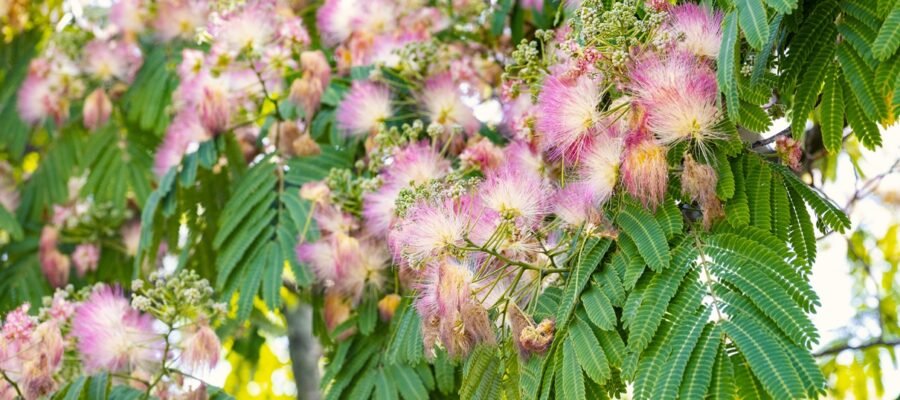
Pink feathery tufts fluctuate following the rhythm of a melody, dictated by the wind. Take a seat in the shade of an Albizia and experience the lightness of the moment.
ETYMOLOGY
The mimosa tree (Albizia julibrissin) has many other names. The most common are Persian silk tree, Constantinople golden acacia, Gaggia arborea, and Rosa siris. Other names include Lencolan golden acacia and hybrid tamarind.
There are also some more general, and sometimes misleading, names such as Chinese silk tree, silk tree, and mimosa.
However, names associated with the plant’s peculiar habit of slowly closing its leaves at night or during the rainy season are particularly interesting. For example, the Persian word “shabkhosb” means “to sleep,” the Chinese word “” (literally “to close happily”) symbolizes a happy couple lying in bed, and the Japanese words “nemunoki,” “nemurinoki,” and “nenenoki” all mean “sleeping tree.”
TAXONOMY
It is part of the Fabaceae family.
The genus Albizia includes approximately 150 species of deciduous trees, bushes and climbers, often located in areas with poor soils in tropical and subtropical areas of Africa, Asia and Australia.
They are plants generally cultivated for their high ornamental value given by the foliage and fan-shaped flowers, which are very particular and decorative.
MORPHOLOGICAL DESCRIPTION
The mimosa (Albizia julibrissin) is a fast-growing but relatively small tree, reaching a height of 5-12 meters.
The bark is light gray with light-colored vertical stripes that gradually become more prominent as the tree grows.
The leaves are 20-45 cm long and 12-25 cm wide, bipinnate compound leaves, and a beautiful light green color. As mentioned earlier, the leaves close like a book during nighttime rain or insufficient sunlight.
The mimosa blooms throughout the summer, attracting many visitors. The white and pink stamens on the inflorescence are particularly striking. Bees, butterflies, and hummingbirds are very fond of this flower.
After flowering, a green pod about 10-20 cm long develops.
HABITAT
Albizia julibrissin is native to Iran, Azerbaijan, China and Korea.
However, it is also planted and grows without problems in California, Texas and Oklahoma.
CARE AND CULTIVATION
TEMPERATURE
it is very resistant to frost, and can even withstand temperatures of -20°C. However, it does not like cold winds.
EXPOSURE
Loves direct exposure to the sun. It also tolerates partial shade conditions but the blooms will not be able to express themselves at their best.
WATERING
It is drought tolerant, but without water the tree will start to look quite sickly. In the case of a young plant, it will need regularly irrigated soil, in order to keep the soil moist, while for adult specimens rainfall is usually sufficient, in case of dry periods it is advisable to water manually.
SUBSTRATE
It does not have great demands on the soil, tolerates a wide range of conditions, including poor or alkaline soils. However, with well-draining and fertile soil it will develop much better 😉
FERTILIZER
From spring to autumn it is possible to administer a granular fertilizer once a month, in case of a prompt effect. However, if you prefer a slow release fertilizer, 3 fertilizations will be enough: one in March, one in June and one in September.
PRUNING
Between January and February it is possible to proceed with pruning which aims to give the desired shape to the plant, be it an inverted cone, a small tree or simply or to contain its size.
Pruning must be done rather delicately.
PROPAGATION
It can be propagated by seed in spring or by cuttings during summer.
PARASITES AND DISEASES
Albizia is vulnerable to red spider mites and scale insects.
Ultimas Entradas Publicadas
4 reasons to adopt Philodendron brandtianum, the perfect houseplant!

Various models and big discounts in the summer sales: the deal of the day

Let’s talk about Christmas decorations

– Complete calendar of holidays and events

Our favorite seasonal rugs and design tips

The most inspiring Christmas gift perfumes 2025: ideas for him and her
Camellia sasanqua, winter flower – Online Plant Sales
What is happening to our Planet?
How to build a greenhouse for succulents: practical guide