
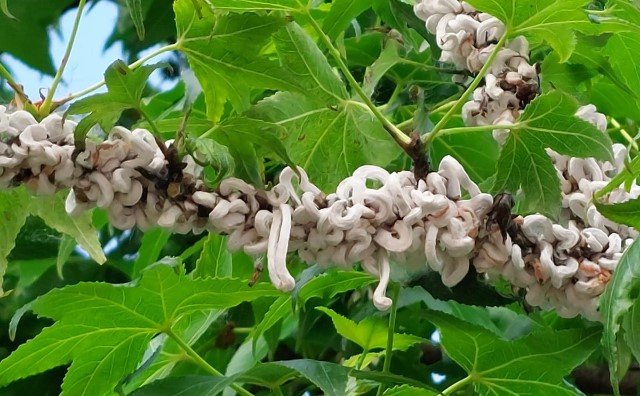
If you are residing in towns in the areas of Milan, Varese, Monza Brianza and Como, you might have spotted unusual white circles hanging from the branches of some trees. They appear like ribbons or somewhat unsettling ornaments. But what exactly are these shapes? Let’s explore why we see white circles on plants.
White circles on plants: A new bug from Japan
Following the introduction of the Popillia japonica from the Asian bedbug of the Anoplophora chinensis and others, we are now faced with another bug from the East: the Takahashia japonica.
Takahashia japonica is an insect from the East that belongs to the Coccidia family. It was first noticed in 1896 on mulberry trees (Morus spp.) in Japan and is also found in China, South Korea, and India. It is extremely polyphagous as it can damage many different plant types.
A mealybug, indeed. But with flair. Like a Yuri Chechi of the insect realm, this one adores circles.
What are those white rings on the trees?
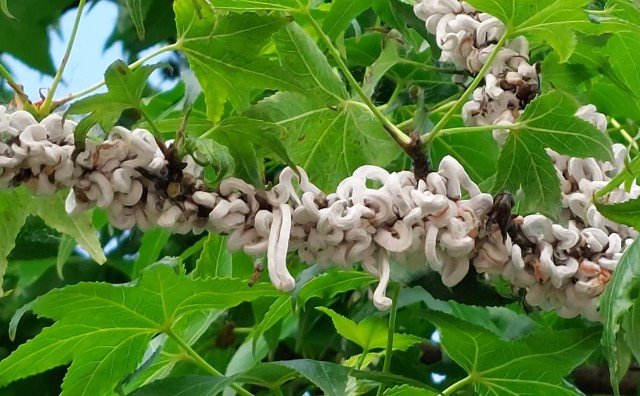
White rings on plants: Which plants are affected by Japanese mealybug
The white ring formations seen on trees such as:
- Acer spp. (above all Acer pseudoplatano)
- Albizia julibrissin
- You are looking for a forest (Judas Tree)
- Carpinus betulus (Hornebe)
- Black mulberry And White mulberry (Mulberries)
- Elm spp. (Elms)
- Liquidambar styraciflua
…they are not artistic decorations but ovisacchi of one Japanese cochineal: THE Takahashia japonica.
Why specifically in Milan?
It is no coincidence that many cases are recorded near Malpensa. Planes, people, suitcases, hair. Maybe your hair, if you’ve recently been to Tokyo. Coincidences? 🌚
What is Takahashia japonica?
Identikit of the insect
Originally from Japanwhere it was described for the first time in 1896, this species has subsequently spread to other Asian countries such as China, South Korea and India. Its first appearance in Europe was recorded only in 2017, in Cerro Maggiore (MI), where it was identified on a specimen of Liquidambar styraciflua. Belonging to the Coccidae family, it is a polyphagous insectcapable of attacking numerous plant species. Currently its presence is documented in several provinces of Lombardy, including Milan, Varese, Monza Brianza and Como.
Ovisacchi: how to recognize them?
These waxy structures, which can reach even i 7cm longthey are particularly resistant to atmospheric agents such as rain, cold and bad weather. Inside they contain thousands of orange-colored eggs and attach themselves firmly to the branches of plants, particularly near pruning cuts, where they find favorable conditions for development.
Does Takahashia japonica harm plants?
At the moment, according to the Phytosanitary Servicethey are not here serious damage observed. However, in case of heavy infestations, drying of the branches may occur.
Good news: it is not dangerous for humans or animals.
Life cycle of Takahashia japonica
Only one generation per year
- Spring (April-May): adult females produce ovisacks
- Egg Schlusa: they come out neanidis (small scale insects)
- The nymphs migrate on leaveswhere they grow by sucking sap
- In the summer they become nymphs
- In fall they return to the branches and there they overwinter
- The cycle starts again in spring
How to fight Japanese mealybug
Physical interventions
- In case of localized infestations: phytosanitary pruning to remove infested branches
- No effect using insecticides directly on the sheep bags
Chemicals (with caution)
Currently there are no specific insecticides officially approved. However, the literature suggests:
- Acetamiprid (no longer on free sale)
- Alternatively: Flupyradifurone (e.g. Sanio)
Sustainable (and DIY) approaches
Recommended treatments
- Mineral oils: at vegetative growth or after hatching, they suffocate the juvenile forms Examples: mineral oils or even vegetable oils (soya, sunflower, flax)
- Neem oil + orange essential oil dosage: 10 ml of neem + 8 g of orange in 1 liter of water
- Potassium soft soap to add to the above mixture (10 ml)
- Microbiological preparations (e.g. Lecanicillium lecanii) In experimental phase
- Endotherapeutic treatments At the moment, little data is available
Predatory insects
- Adalia bipunctatawas observed in the presence of T. japonica
- The real impact on a large scale is not yet known
How does it spread?
Takahashia japonica spreads by traveling exploiting the wind: in the presence of monospecific trees or through passive transport: by means, tools, infested plants, pruning.
Ultimas Entradas Publicadas
4 reasons to adopt Philodendron brandtianum, the perfect houseplant!

Various models and big discounts in the summer sales: the deal of the day

Let’s talk about Christmas decorations

– Complete calendar of holidays and events

Our favorite seasonal rugs and design tips

The most inspiring Christmas gift perfumes 2025: ideas for him and her
Camellia sasanqua, winter flower – Online Plant Sales
What is happening to our Planet?

How to build a greenhouse for succulents: practical guide