
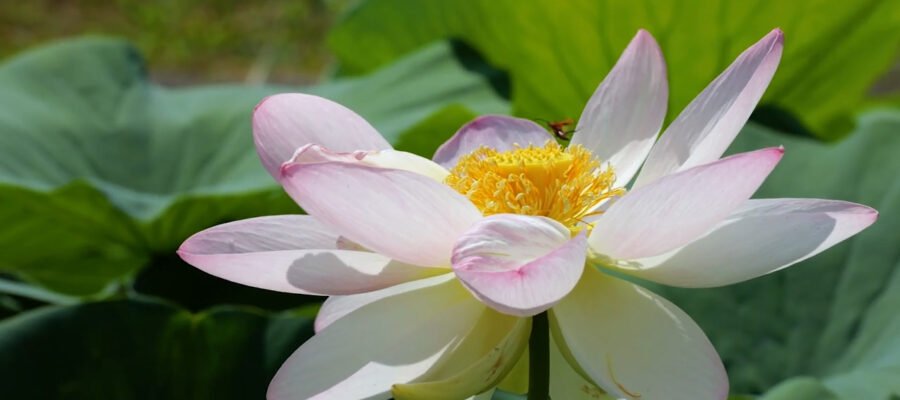
Along the stream leading to our nursery in Brescia, bleeding hearts (Nelumbo nucifera, also known as Asian lotus) bloom year-round, a remarkable aquatic plant.
The lotus, a masterpiece of nature, a symbol of beauty and spirituality, has captivated humankind for centuries. This extraordinary flower belongs to the Nelumbonaceae family and boasts a rich and profound history in many cultures around the world.
Native to Asia, the lotus is considered sacred in many religious and philosophical traditions, such as Hinduism, Buddhism, and Taoism. It is renowned for its remarkable ability to grow tenaciously in mud, displaying pure beauty.
care and meaning of an aquatic plant

The Lotus can be cultivated starting from rhizomewhich can be buried in a container at a depth of 5 cm, taking care to let the shoots protrude from the ground. The vase should then be immersed in water, keeping the upper part at a depth of 5-10 cm.
What exposure to give to the Lotus Flower
Lotus flower plants require many hours of direct sunlight to grow and prosper.
Which substrate to choose for the Lotus Flower
To grow the Lotus Flower it is necessary to use a large container filled with heavy soil, the soil in which they are grown must be dense and the ideal is for it to be clayey.
What temperatures does the Lotus Flower want?
The Lotus Flower is rutic to frostconsider that on the seabed the water temperature never drops below 4°C.
In winter it is possible to remove the water and place the rhizome in a cold veranda, garage, etc. In these cases the important thing is that the soil is dry and that there is no humidity. You can also dig them out of the ground, clean them, wrap them in some paper and keep them over the winter in a dark, cool and dry box.
How to fertilize the Lotus Flower
The use of slow-release granular fertilizers in tablet form (e.g. Osmocote) is recommended.
How to propagate the Lotus Flower
The propagation of the Lotus is very rapid as it is a plant that tends to expand with considerable ease: every approximately 3 years, during the winter season, is a good rule reduce the rhizomes; from this operation it is possible to obtain material to give life to new plants. They can also be used for this purpose seedstaking care to scrape the hard surface cuticle to facilitate water penetration and activate germination (acting delicately and using sandpaper); in fact, in natural conditions the seed can remain isolated for many years before germinating.
The Nelumbo nucifera is also known as Blue Lot, Sacred lily or Indian bean.
The Nelumbo genus (to which the Lotus Flower belongs) is part of the Nelumbonaceae family. The Nelumbo genus was the only one belonging to it to differentiate around 80 million years ago.
The Nelumbo genus in turn is divided into only 2 species:
- Nelumbo lutea It comes from Central and South America, but since ancient times it has been cultivated by the natives of North America to use the seeds and rhizomes as food. This variety has been crossed with N. nucifera giving rise to numerous hybrids with very high aesthetic value.
- Nelumbo nucifera it is a resistant species, commonly known as the Asian Lotus Flower. It is an aquatic plant that grows quickly and is typical of ponds and reservoirs with calm or almost current-free waters, with a depth between 5 and 50 cm, but can reach up to 250-300 cm.
Scientists report that the lotus possesses an astonishing ability to regulate the temperature of its flowers within a narrow range, similar to the regulatory mechanisms of humans and other warm-blooded animals. However, it was once thought that the lotus used this method to attract cold-blooded pollinating insects. A study conducted at the Adelaide Botanic Gardens by physiologists Roger S. Seymour and Paul Schultz-Mottle at the University of Adelaide in Australia found that even when the temperature drops to 10 degrees Celsius, the lotus can maintain a constant temperature of 30-35 degrees Celsius.
The lotus is unique in its physical characteristics: its common pink and white flowers (petals may also be yellow or purple) emit a distinctive anise-like aroma. Its leaves are bluish-green with a slight blue tinge, smooth, and can reach up to 60 centimeters in diameter. They can even protrude above the water surface (read this article to learn more about lotus leaves). Even raw, the fruit is highly ornamental and can be dried for use in flower arrangements. The flower is composed of many overlapping petals, forming a cup-like structure.
It can harmoniously complement water lilies, water hyacinths, and irises in water gardens.
Lotus and water lily are often confused and sometimes even mixed up, but they are plants with very different characteristics.
- the Nymphaea has smaller leaves and flowers which normally do not rise from the surface of the water, unlike the Lotus;
- the leaves of the Lotus Flower have the self-cleaning mercury effect, while the Water Lilies do not;
- the water lily has many more colors than the flowers;
- the depth of the Lotus Flower can reach up to 2 meters, that of the Water Lily up to 60-80 cm.
Lotus effect on the leaves of the Lotus Flower
Since ancient times, this essence has aroused admiration within the Buddhist and Hindu traditionswho venerate the Lotus as a sacred flower. In particular, in Buddhism, the Lotus represents the essence of human life (Buddhahood) which, although it remains immaculate, has its roots in the slime of reality. Without the slime, the Lotus cannot exist, just as the Buddha manifests himself through the tribulations of daily life. Furthermore, the Lotus develops fruit and seed simultaneously, thus symbolizing the Buddhist law of cause and effect.
According to legend, in every place where Buddha took his first steps, lotus flowers bloomed. In traditional Asian literature, it embodies a sense of grace, sophistication, splendor, purity and excellence, so much so that deities are often depicted sitting on it.
Lotus flowers are distinguished by their shade:
- Celestial flower: symbolizes the triumph of spiritual essence over matter, wisdom and knowledge. It is a variety of flower that tends to be sealed, revealing those who hide their true essence.
- White flower: represents the perfect harmony of the spirit and mind, the purity and integrity of nature.
- Red Flower: Talks about the heart, its pure innocence, passionate love and understanding. It is also known as the flower of the Compassionate Buddha.
- Pink flower: it is the most emblematic flower and is associated with deities, such as the Buddha.
A true Odyssey
In the Odyssey, Ulysses and his sailors landed on the island of the Lotus Eaters. The Lotus Eaters were a peaceful people who offered them lotus fruit to eat. This fruit had an amazing and magical effect, making the sailors forget their homes and their responsibilities, making them want only to stay on the island. Ulysses, fearing to lose his men, ordered them not to eat the lotus and to bring back on board those who had tasted it. Ultimately, he managed to convince his sailors to leave, thus avoiding being trapped in the insatiable desire for the lotus fruit.
The extraordinary longevity of the seeds
During an archaeological excavation in 1951 in Kemigawa, Chiba Prefecture, Japan, three seeds were accidentally found which were later identified by the botanist Ichirō Ōga as lotus seeds. What made this finding even more surprising was the result of radiocarbon tests, which established that these seeds date back more than two thousand years ago. Thanks to the careful care of Professor Ōga, one of the three seeds managed to germinatebringing back to life what has been defined as “the oldest flower in the world“and which was named Ōga lotus (sometimes also written Ohga) in honor of its discoverer. Today, this flower represents a famous attraction in Chiba Park, where it was found, and in the Kōraku-en garden in Okayama, Professor Ōga’s hometown.
Where did the lotus flower originate?
The Lotus Flower originates in Asia and Australia.
Can the Lotus Flower really have thousands of petals?
Several cultivated varieties have a surprising number of sepals. Among which, the Chinese variety called qian ban lian (which not for nothing means “Lotus with numerous sepals”) can count between 3000 and 4000 sepals in a single flower, while the Japanese variety oh my dear (“Extraordinary Lotus”) can boast between 2000 and 5000 sepals, thus setting the record for the greatest number of sepals recorded in any plant species.
Ultimas Entradas Publicadas
4 reasons to adopt Philodendron brandtianum, the perfect houseplant!

Various models and big discounts in the summer sales: the deal of the day

Let’s talk about Christmas decorations

– Complete calendar of holidays and events

Our favorite seasonal rugs and design tips
The most inspiring Christmas gift perfumes 2025: ideas for him and her
Camellia sasanqua, winter flower – Online Plant Sales

What is happening to our Planet?

How to build a greenhouse for succulents: practical guide