
If you follow us on social media, you’ve probably seen it already. We never miss an opportunity to showcase it; it adds a unique charm to everything we do. In fact, it’s hard to forget it.
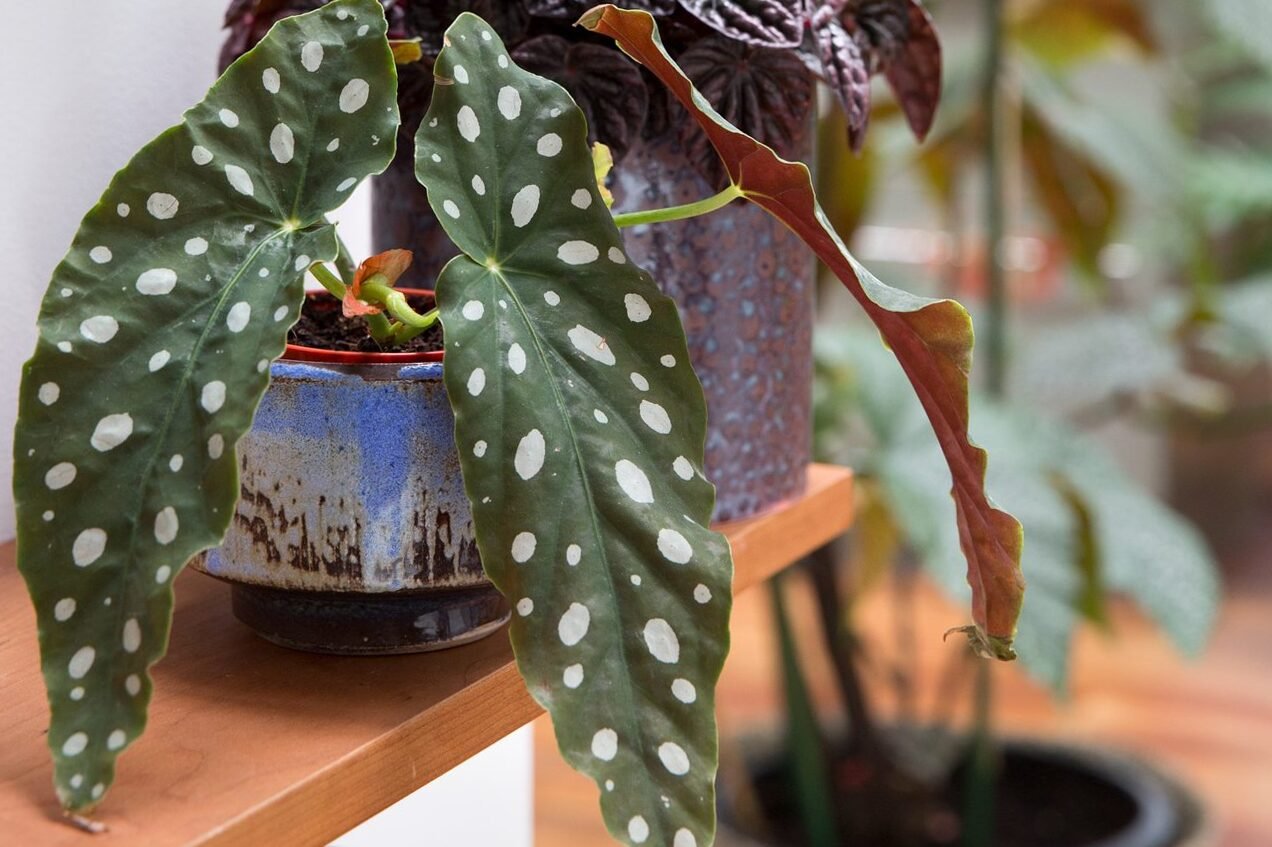
What’s captivating isn’t its beautiful flowers, but its distinctive leaves. It’s a spotted plant—isn’t that fascinating? Many varieties have spotted leaves, but none are as striking as this one. This is because its leaves create a striking contrast between the vibrant green on the upper surface and the bright red on the underside. Let’s take a moment to admire one of the most beautiful begonias.
BEGONIA MACULATA WIGHTII
Begonia maculata belongs to the large Begoniaceae family. It was discovered in Brazil in 1982 think about it: by an Italian researcher. We can really be proud of having contributed to the knowledge of this plant!
It grows in humid subtropical and tropical climates, yet, indoors, it does not like excessive temperatures.
The Begonia maculata is splendid perennial plant that reaches a height of about 1.5 metres. The leaves are generally asymmetrical and can reach 20cm in length. The upper surface of the leaf is usually dark green with silvery-white spots, while the back is deep red. Don’t worry if they don’t have these characteristics at the beginning, in fact the younger leaves are generally pink/brown.
The flowers usually form in single groups and can vary from white to pale pink, the flowering period begins at the end of winter and continues throughout spring. Once they have faded, it is advisable to remove them, by doing so the plant will be stimulated to produce new buds.
The Begonia maculata can remain safely indoors all year round, but it is also possible to take it outside during the warmer months. Just remember to keep it out of direct sunlight!
TAKING CARE OF YOUR BEGONIA MACULATA
The Begonia maculata is resistant and adapts quite well to environments. But let’s see how best to take care of it!
EXPOSURE
It particularly loves light, as long as it is not direct. Then choose a shielded light position for her.
TEMPERATURE
We always keep in mind that we are talking about a tropical plant and this excludes it from feeling comfortable in harsher climates. Its ideal temperature is in fact between 18 and 22°C, if you really want to put it to the test, know that it can still resist temperatures of around 15°C, but they certainly do not represent an element that will favor its regular development.
WATERING
Watering represents the challenge of spotted begonia. In fact, it may not be too easy to find the right balance.
First of all, the soil must always retain some humidity, without however being wet, as it is a plant extremely sensitive to root rot. Therefore, before watering, try inserting a finger into the soil. If you feel that the soil is dry in the first 2-3cm, then it is time to wet it. If you have any doubts, it’s better to wait.
LAND
The ideal soil for spotted begonia is a mixture of sand and clay. Let’s not forget that the soil must also offer good drainage, so it is a good practice to add expanded clay, pumice or other coarse material to the bottom of the pot that helps the soil get rid of excess water.
If you already want ready soil for your Begonia maculata (and also for other houseplants), we recommend you choose our Florenpot.
FERTILIZATION
The spotted begonia requires very regular fertilization: about once every two weeks so that it can produce healthier leaves and flowers. A little advice is to only use half the dosage recommended on the label of the chosen product.
MULTIPLICATION
Propagation is not difficult, especially if you choose to do it through cuttings. It is advisable to take the cutting in the coldest periods, when flowering activity is at its minimum, in fact the necessary stem must not have flowers. What you need to do is just take a stem, remove the lower leaves and immerse it in a jar of water until roots begin to form. Then it will be sufficient to plant it in the ground and keep it watered according to the instructions given previously.
PRUNING
In addition to removing the flowers when they have faded, to ensure that the plant develops lush foliage, it is recommended to prune it regularly during the summer and spring months. Without exaggerating, it will be sufficient to cut the overgrown branches just above the bud, about halfway along their length.
So, what do you think? Did it hit you? We absolutely advise you to give Begonia maculata the chance to make your environments even more characteristic and particular, you’ll see it won’t disappoint you!
Ultimas Entradas Publicadas
4 reasons to adopt Philodendron brandtianum, the perfect houseplant!
Various models and big discounts in the summer sales: the deal of the day

Let’s talk about Christmas decorations

– Complete calendar of holidays and events

Our favorite seasonal rugs and design tips

The most inspiring Christmas gift perfumes 2025: ideas for him and her
Camellia sasanqua, winter flower – Online Plant Sales
What is happening to our Planet?
How to build a greenhouse for succulents: practical guide