
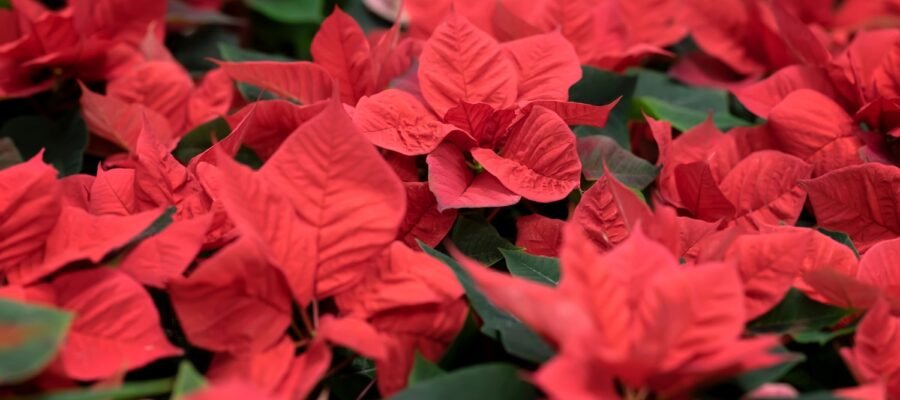
Every promise is a debt, so here we are to talk about the Christmas Star! In the previous article (5 plants to give as gifts at Christmas), we mentioned that the main star of the holidays required its own piece. This is because the Poinsettia, or Euphorbia pulcherrima, is a plant that truly merits recognition!
The name itself conveys a lot. In fact, if its most common name already indicates that it is the queen of Christmas, the botanical name suggests its beauty. Euphorbia identifies the genus to which the plant belongs, but “Pulcherrima” emphasizes its beauty, as if to mark it as the most beautiful among the Euphorbiaceae.
This evergreen deciduous shrub grows significantly when it is in the wild, to the point that it can attain a height of 2-3 meters! In domestic settings, however, it tends to grow much more modestly, usually not surpassing one meter.
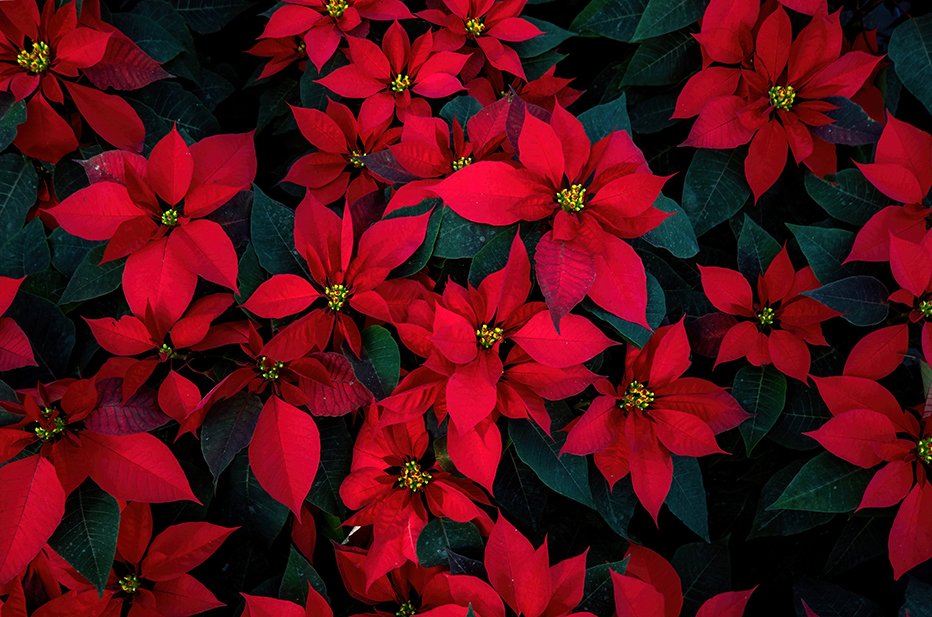
Seeing it, it is easy to think that the “red leaves” are actually the flowers of the plant, but this is not the case. In fact, the Christmas Star produces small, rounded green or yellowish flowers, gathered in inflorescences made up of 4-8 small flowers.
While the “red leaves” are actually bracts, meaning modified leaves that accompany the flowers and protect them. Usually, the bracts are green, but in some cases, like this one, they display bright colors that quickly attract attention, serving as a visual cue for pollinating animals.
In winter you can enjoy these magnificent colors, while during the rest of the year the Christmas Star rests, appearing as a small bush with green leaves.
However, numerous varieties of Euphorbia pulcherrima exist, resulting from hybridizer experiments, each differing in various aspects including color (which can be pink, yellowish, or white) or in the shape and number of leaves!
How to care for the poinsettia
Ah, what magic this plant spreads, but let’s face it, it also brings with it some headaches, especially related to its survival.
After all, how many of us, caught up in the Christmas spirit, have purchased one, or received it as a gift and, after the holidays, we have remained to observe its slow decay? This year Let’s say enough about the less than decorous end of these magnificent plants! Let’s get to know them and understand how to keep them at their best even during the rest of the year.
Where to place the Christmas Star
The Christmas Star loves natural light and disdains the artificial one.
Where to keep the poinsettia in winter and when to put it in the dark? During the winter months it must not exceed eight hours of exposure to light and, assuming that it remains in contact (not direct) with the sun’s rays from 8 am to 3 pm, it would then be ideal to place it in a dimly lit area without artificial light.
Poinsettia: temperature
The ideal temperature is between 12 and 25 degrees, it must be absolutely taken into consideration that the Poinsettia cannot tolerate heat sources (fireplaces, ovens, radiators, etc.).
In reality, the Christmas star is able to withstand slightly lower temperatures, such as those found in stairwells, but it must reach them gradually. As soon as you buy them or perhaps directly for the entire first year, keep them in the apartment and then if you want to move them, do it calmly and let the plant get used to it.
Watering the poinsettia
Water is essential to keep our poinsettia alive! Irrigation must be done only when the soil appears dry and water stagnation in the saucer must be absolutely avoided.
Is your poinsettia losing its leaves? The remedies: given that the leaves are very delicate and tend to dry out easily, the ideal would be to place some expanded clay at the foot of the vase. The expanded clay granules retain water and release it, generating a type of humidity that the poinsettia really likes.
Poinsettia fertilization
From the end of May until September, every two weeks, the ideal is to dilute a liquid fertilizer with high percentages of phosphorus and potassium in the water used to water the plants.
Pruning the poinsettia
Poinsettia pruning is very simple, if the poinsettia has dry leaves, just cut them with scissors. However, it is advisable to wear protective gloves, as the latex that flows through its branches can be stinging.
As time passes the Poinsettia will tend to “empty” downwards and produce more leaves in the upper part of the branches, for this reason it would be better to intervene once spring arrives shortening all the branches by about a third, thus encouraging the development of new shoots.
Where to keep the poinsettia in summer
Did your poinsettia survive the winter? We have reached April and it still has some leaves and maybe even some red bracts? If you are singing with joy we understand, making the Poinsettia survive is truly a satisfying mission, but don’t get too distracted, this is not the time to let your guard down!
Don’t worry, even with the arrival of spring, the care you will have to give to the plant will be the same as always.
In summer, however, the Christmas star can be placed outside and then brought back to a dark place around October. Just pay attention to the end of the risk of frost before putting your plants out, or you will see all your efforts vanish.
When winter returns, to ensure that the bracts turn red again, it will be sufficient to keep the plant in a position where light reaches it only for 6-8 hours a day and where it is protected from artificial light.
Is the poinsettia poisonous?
Well yes, it may seem strange but it is still true. Poinsettia is poisonous. For humans the risk is very limited, as it is the sap (milky substance that flows in the branches and trunk) that is irritating to the skin and generally not very seriously. A very different matter is represented by our four-legged friends; in fact, the poinsettia can be toxic to dogs and cats if ingested (even if it is not normally lethal). We have therefore loved this plant for all its history and its particularity, but if we have no way of keeping it out of the reach of our animals it is better to limit ourselves to observing it on the streets, thus avoiding possible risks.
A famous rumor would attribute the poinsettia to the cause of death of a child who had eaten it, but this is only a rumour, in fact in 2008 the American Association of Poison Control Centers examined over 800 cases of exposure or ingestion of the plant, including 92 children who had eaten a certain quantity of leaves, but did not highlight any danger to health.
The Christmas Star, in addition to being the protagonist of Christmas, is also the auspicious symbol par excellencefully representing the spirit of rebirth and serenity typical of this time of year. All this not only makes her beautiful, but also a perfect gift to give!
Origin of the Christmas Star
The Christmas star, or Euphorbia pulcherrima, originates from Mexico and has been cherished since Aztec times. It has been linked to Christmas since the 16th century. However, it only became a worldwide symbol in the early 20th century.
In 1804, the Christmas Star reached Europe thanks to scientist Alexander von Humboldt and was first cataloged in Berlin as Euphorbia pulcherrima. However, in 1828, Joel Roberts Poinsett introduced this plant to the United States, where it was named Poinsettia in his honor. It is worth noting that December 12, the anniversary of Joel Roberts Poinsett’s death, is celebrated worldwide as “Poinsettia Day”!
But in America, bringing a plant and hoping that its beauty will win people’s hearts is not enough; you need more—you need the scene! And so, like any self-respecting great star, Euphorbia pulcherrima also had to begin the journey of a superstar.
At the start of the twentieth century, Paul Ecke, captivated by the vibrant colors of the plants growing wild near his California farm, started cultivating and selling the poinsettia in the United States. This venture was highly successful, but it was only when his son, Paul Jr., decided to sell it to the top shops on Sunset and Hollywood Boulevard in Los Angeles that the Christmas Star began to be distributed nationwide.
In 1950, another significant milestone was achieved that would lead to widespread diffusion: German growers succeeded in cultivating it as a houseplant. In fact, while it was previously only possible to grow it outdoors, it now also became suitable for indoor environments, no longer being as affected by closed spaces and heating.
Of course it must be said that there are around 150 varieties of Ephorbia pulcherrima, some more or less predisposed than others to stay in domestic environments.
In short, what more can be said about this plant that first began its journey to fame right on Hollywood’s streets? Well, many things! After all, we are only at the start of this article.
The legends of the Christmas Star
But the story of the Christmas Star does not end here: the legends it brings with it are very varied and have their roots in many cultures. For example, earlier we mentioned the Aztecs, among them the plant was known as Cuetlaxochitlwhich means “skin flower” and was used both as a decoration for temples and worshiped as a symbol of new life, in honor of the warriors fallen in battle. Furthermore, more practical uses were not disdained either, such as the pigments for fabrics and cosmetics obtained from its bracts.
The icing on the cake is the legend that Euphorbia pulcherrima was the favorite plant of Montezuma, the ruler of the Aztecs, convinced that the red color of the main leaves came from the blood of an Aztec goddess who died of pain for an unrequited love, whose drops fell on the leaves giving them that characteristic crimson color. Traces of this legend can be found in the French name of the plant “star of love”, Star of Love.
Instead, a different legend originates from the Christian faith.
We remain in Mexico on Christmas night.
Baby Jesus has just been born in his manger, and little Pepita wishes to give a gift that represents his love.
Pepita, however, is very poor. So, all she has to do is go out and pick some weeds from the side of the road. She makes a bouquet of them and takes them to church, hoping that the love that drives her will still be recognized in her gesture.
During the Christmas mass, something unexpected occurs: the small bunch of herbs transforms, sprouts, and is tinged with vibrant reds and greens. From this point forward, the Christmas star is called “Flores de Noche Buena” by Mexicans and becomes the most emblematic flower of Christmas.
This is simply a variation, but if you want to learn more about the subject, numerous versions of this story can be found online! Well, dear friends, we have encountered this star; all we can do is wish you the best for your holidays!