
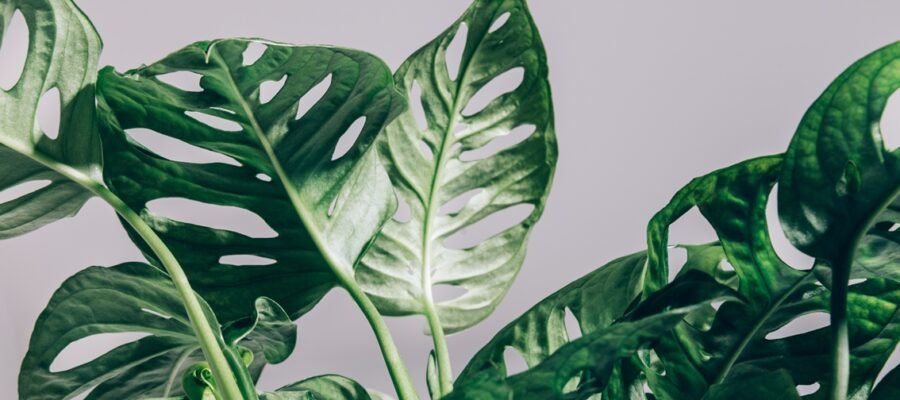
Today we are going to meet what could be an old acquaintance.
In what sense? Well, we had already talked to you about Monstera deliciosa and Monstera dubia but today we go a little further into its relatives, introducing you to Monstera adansonii, also known as Monstera Monkey Mask.
So let’s forget about the very large “monstrous” leaves of the Monstera deliciosa and get to know what could be considered a little sister, smaller and more mischievous.
Like the Begonia Maculata and the Maranta, but also like its big sister Monstera, the Monkey Mask is well known for its very peculiar appearance. Native to South America, it is also widely used by us to make environments a little out of the ordinary, and it is also very easy to take care of, so don’t underestimate it!
La Monstera monkey mask
As we said before, the Monstera Monkey Mask is mainly native to South America, in nature it tends to favor areas close to rivers. It can also easily be found in Central America and the West Indies.
Its characteristics leaves are large, heart-shaped and covered with holes of various sizes. Generally the dimensions range from 21-42cm.
It’s a bit strange to think about the leaf development of this plant, after all, why is it “designed” to develop pitted leaves? Scientists have naturally tried to give an answer, hypothesizing that this phenomenon derives from the need to compete with a large number of plants in order to reach the light. In this way the Monstera would be able to extend its area without wasting energy on a fully developed blade. Nature’s ingenuity never ceases to amaze!
Furthermore, Monstera adansonii is part of the NASA study done in the 1980s to purify the air. Do you want to know more? We talked about it in this article!
Monstera adansonii, Monstera Monkey Mask…and many other names!
This nice variety of Monstera, despite being only one, has many names! Among the many we find “Adanson’s Monster”, “Five Holes Plant”, the now well-known “Monkey Mask” and, among the most curious we find “Swiss Cheese Vine”.
Are you wondering why it is also lumped together with Swiss cheese? Well, precisely because of its shape: perforated, small and compact!
Care and cultivation of Monstera Monkey Mask
The Monkey Mask is quite simple to grow but it really doesn’t compromise on some aspects, which ones? Let’s find out!
Where to place the Monstera Monkey Mask?
Considering that the Monstera Monkey Mask is a plant that grows in dimly lit jungles, it’s not hard to understand what it takes to make it feel at home. This Monstera prefers to stay in bright areas but not exposed to direct sunlight.
The ideal temperatures for Monstera adansonii
The Monstera Monkey Mask prefers environments with a temperature between 18 and 27°C. Temperature is not a vital aspect for the plant, being able to adapt very well, however below 17°C it will struggle to grow, slowing down its natural rhythm.
How much water to give Monstera Moneky Mask?
Here’s the real sore point. In general, the Monstera Monkey Mask is a simple plant, but when it comes to water it is necessary to pay particular attention.
These plants should be watered regularly, making sure the soil always remains moist. It is necessary to find a happy medium between the doses of waterin fact, if too little would cause it to dry out, too much would cause root rot.
Which substrate to use for Monstera adansonii?
I repeat it all the time now, but given its importance for most plants, I never tire of saying it again: the soil must be very draining. Once you are sure that the soil allows a good level of drainage, the rest is secondary. However, it would be ideal to use excellent quality, well-draining soil, such as our One plus.
How to fertilize Monstera Monkey Mask
The fast growth of Monstera Monkey Mask requires a good dose of nutrition, which is why it is recommended to fertilize it regularly with a liquid fertilizer for green plants.
Come propagation in Monstera adansonii
It is not difficult to get babies from your Monkey Mask, especially if you choose the method for cutting. Just remember that you must first root it in water and only then put it in a vase.