
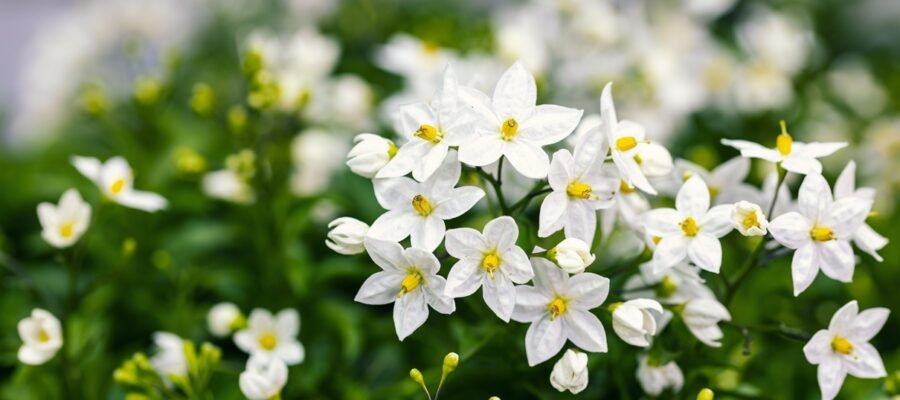
Today we breathe the fragrant notes of Night Jasmine, a spectacular flower that will capture the attention it deserves!
ETYMOLOGY
Solanum jasminoides (or San Lasso) is known in Italy by the common name of Gelsomino di notte.
In English it is known by the names of The potatoes are arriving and of Jasmine nightshade.
TAXONOMY
The genre Solanum belongs to the family of Solanaceae and has around 1400 species of plants ranging from herbaceous perennials to evergreen trees, from annuals to shrubs, and is widespread in different habitats on the planet. It is a genus that is also well known for hosting numerous vegetables that we usually eat: for example, Potato (S. tuberosum), Tomato (San tomato) and Eggplant (S. melongena).
A very poisonous plant that we already know also belongs to this genus: Belladonna.
MORPHOLOGICAL DESCRIPTION
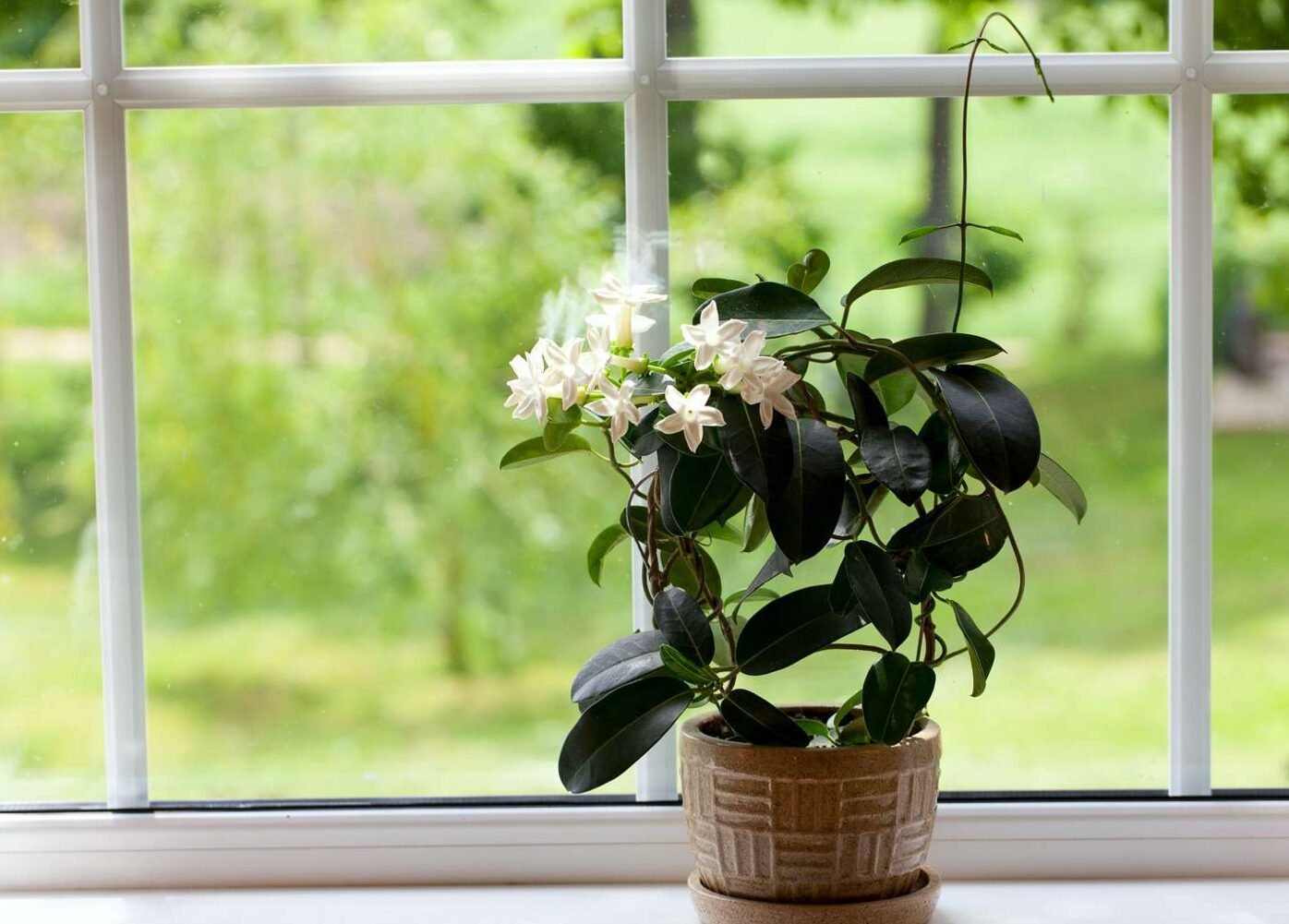
It is an evergreen climber (with semi-persistent leaves in harsh winter areas) typically used as an outdoor plant. It can be planted in open ground or in large pots (also depending on the desired development).
It has ovate, lanceolate leaves, dark green and shiny, up to 5cm long.
Its long shoots bear 2-3 cm blue-white flowers (the yellow anthers are clearly visible in the center), arranged in axillary or apical bunches 5-8 cm wide. As in the classic Jasmine, its flower has an intense and pleasant scent but that of Solanum jasminoides it feels less heavy. Its wonderful flowering begins in spring and lasts until November.
Worth mentioning is the ‘Album’ variety with pure white flowers.
The black, shiny and ovoid-shaped fruits then appear from the flowers, just under a centimeter in diameter.
It is a plant suitable for creating excellent scenarios both for its evergreen character and for its climbing habit which makes it suitable to be used to decorate porches, facades, fences and arbours, reaching up to 6 meters in height.
Its rustic and resistant character will make it difficult to kill it, so much so that sometimes it can even be a pest.
HABITAT
Night jasmine is native to Brazil, Argentina and South America in general.
CARE AND CULTIVATION OF JASMINE AT NIGHT
TEMPERATURE
It is a plant that tolerates temperatures below zero, up to -5/-10°C (RHS rating: H4); with frosts it tends to defoliate more but there are no dangers within the above intervals.
A good practice in regions that do not enjoy a mild winter is to mulch the soil before frosts, for example using leaves or straw.
EXPOSURE
It loves positions in full light but also adapts to partial shade conditions. Its ideal place is a nice warm and bright wall!
WATERING
Night jasmine loves moist soil, so it is important to maintain this state. In general, it resists drought well but it is better to water regularly (to understand if it is the right time to water, always use the usual finger technique: if the soil is dry under the first 5cm then it is time to drink!).
SUBSTRATE
The ideal is a neutral or alkaline, moderately fertile soil; it is important that it is, as always, well draining. As always we recommend our trusty One and One plus, both for pots and in the ground.
FERTILIZATION
Especially during spring and summer.
PROPAGATION
The easiest method for propagation is by cutting, but it is also possible to proceed from seed.
PRUNING
Pruning is not always necessary, but it can be done to improve the shape of the plant or in any case to resize it as it grows quickly.
During spring and summer it is possible to carry out pruning without problems, perhaps taking the opportunity to eliminate broken or dead branches. However, it is better to avoid pruning in autumn so as not to weaken the plant just before winter.
PROBLEMS
It is sensitive to attack by aphids and red spider mites.
TOXICITY
Solanum jasminoides contains very toxic elements. Its sap is irritating to the skin, in fact you must be very careful when handling it (the use of gloves is strongly recommended) and in case of ingestion (especially of the berries), especially by children or pets, it is necessary to alert the relevant doctors.