
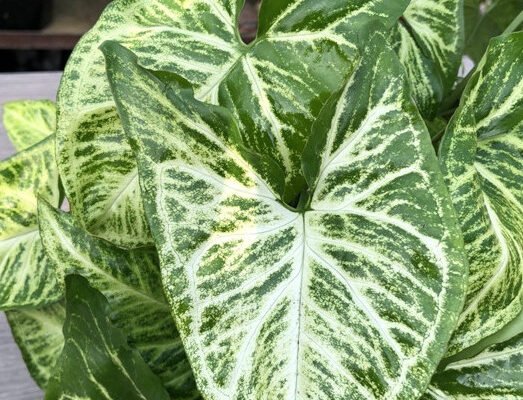
Here we are today talking about Syngonium, a plant that is easy to care for but has many qualities! It is in fact an adaptable houseplant, which can grow by climbing on any sort of support. Furthermore, there are many varieties that will suit everyone’s tastes.
- Care and cultivation of Syngonium
- Exposure
- Temperature
- Watering
- Humidity
- Substrate
- Fertilization
- Propagation
- I repot
- Pruning
- Parasites
- Recurring problems
- Lower leaves dry and brown
- Yellow leaves with a brownish tint
- Syngonium looks floppy
- Stiff leaves turning brown
- Variegation that changes appearance
- Yellow spots on the leaf blade
- Leaf edema
- Description of Syngonium
- Taxonomic description
- Habitat
- Toxicity
- Curiosity
Syngonium: care and cultivation
Syngonium are perfect plants for those approaching the world of greenery for the first time. They can live for a long time without fertilizers (although of course fertilization is always recommended) and are able to adapt to almost any environment!
Where to place the Syngonium
Although these plants are extremely light tolerant, they will grow faster and retain their vibrant color and variegation when grown with medium to bright indirect light.
Be careful, the direct sun or refracted by the glass will burn the leaves. Also keep in mind that variegated foliage requires more light than totally green foliage.
Syngonium can also be maintained with the help of grow lights, especially during the winter months where light is scarce.
Singonium: minimum temperature
Syngonium will be comfortable in most home climates between 15°C and 27°C. The important thing is that temperatures do not drop below 12°C. It is recommended to avoid placing these plants near drafts during the winter months.
How often to water the Syngonium
It is recommended to wait for these plants to partially dry between one watering and another. Generally it is time to water again abundantly when the first 3-5cm are dry to the touch.
When the plant starts to get really thirsty it will start to droop, in this case it is better to immediately remedy this with a good watering!
In the colder months the watering frequency can be significantly reduced.
How to provide moisture to Syngonium
The average domestic humidity which is around 40-50% is already an excellent starting point, if there is the possibility of providing even more humidity the plant will certainly be happy!
In any case, Syngonium can tolerate dry air, but it is better to wash the leaves weekly, also spraying the mossy support that supports it.
Which soil to use for Syngonium
It is important that the Syngonium has a light, airy, porous substrate with coarse elements so that it can drain well, avoiding rotting of the fleshy roots, therefore we recommend using potting soil for houseplants, in particular Florenpot, One or One+.
How to fertilize Syngonium
Syngonium should be fertilized, particularly during periods of increased growth, with a fertilizer for houseplants. Like most houseplants, Syngoniums “rest” in winter but only for a short period; therefore, even in the middle of the coldest months of the year (provided that the room where they are kept is nice and warm) it is normal to see some leaves growing. Consequently, it is fine to fertilize it even in winter, but generally only if the plant is still putting out new leaves.
How to Propagate Syngonium
It is possible to propagate these plants by cutting in spring, cutting in water is particularly recommended for the speed of development. Or it can also be multiplied by branch fragments.
When to repot Syngonium
Like many plants of this type there is much more activity above the ground than at root level, for this reason they are comfortable in small pots and, if well nourished, can remain there for several years.
However, if you notice the need to water more often or that growth has stopped, then it is also time to consider repotting. Approximately it is an operation to be done every 2 years.
How to prune Syngonium
Syngonium does not require excessively complex pruning, but it is still recommended to encourage compact growth and maintain a harmonious shape.
It is advisable to use gloves during pruning operations as the sap of this plant could irritate the skin.
1 Syngonium parasites
Fortunately, attacks by parasites are quite rare but you still need to pay attention in particular to mites, scale insects and aphids.
Most common problems of Syngonium
Lower leaves dry and brown
In the event that the lower leaves of the Syngonium begin to dry out and turn brown, the main cause is to be found in the lack of watering, in this case it is recommended to immerse the soil and let the plant rehydrate.
Yellow leaves with a brownish tone
Here’s another water-related issue, but this time soil left excessively wet for too long. When a plant is overwatered, the soil becomes waterlogged, preventing oxygen from reaching the roots. This type of terrain, almost marshy, becomes the perfect breeding ground for disease and diseases, so it’s better to be careful!
Syngonium looks floppy
This problem may occur when pruning has not been carried out for a long time. The solution is to repot the plant also using a mossy guardian.
Leaves stiff and turning brown
This symptom is indicative of low humidity.
Changing variegation
Generally for houseplants, seeing changing variegation is the result of incorrect light conditions over a prolonged period. It could also be the case with Syngonium but it must be kept in mind that with this plant the leaves change as they mature, both in shape and in variegation, so they could be physiological changes.
Yellow spots on the leaf blade
They are generally caused by an environment that is too dry or by direct irradiation. However, you must pay attention because it is also a typical symptom of mites.
Leaf edema
Too high atmospheric humidity, associated with darkness and a cold climate, produce edema on the leaves, whose tissues, unable to dispose of excess water through transpiration, darken and die.
Description of Syngonium
It is a very peculiar plant due to its varied and colorful aesthetic side. It is available in a wide range of colors and the foliage almost changes appearance as it matures from young to adult.
Over time the stems of Syngonium become climbers, but by keeping the plant pruned it can also be grown upright. If it is not pruned its shoots can grow to almost 2m.
Once the stems have become climbers they produce aerial adventitious roots, which form organs suitable for maintaining the stability of the plant, twisting around branches and support. During this phase the leaves become lobed, divided into 5-9 unequal parts, formed by lanceolate segments, of which the central one is the largest and the basal ones often have two smaller, lateral lobes.
The leaves take on a typical heart shape, so much so that in English-speaking languages it is often called “Arrowhead”. The young leaves arise from the sheathing petiole of the previous leaf, are supported by erect peduncles and have a sagittate shape, exactly like an arrowhead, with stronger and bolder variegations. As the plant ages the leaves change shape to give a lobed finish.
The color of the leaves varies from variety to variety but can cover this chromatic range: green and white, silver, cream, pink and even purple.
They will not be the main attraction of this plant and are quite rare in plants kept indoors, but it is also capable of flowering, although the flowers are not as scenic as the foliage. The latter are white/greenish and very small in size. After the flowers, brownish-black or red berries develop.
Taxonomic description
Syngonium belongs to the Araceae botanical family.
It is a genus composed of approximately 36 species of climbing evergreens. It is very similar to Philodendron, but usually less vigorous.
Syngonium can sometimes be found under the name “Nephthytis”, this is because they were originally confused due to their similar appearance. It still retains this common name, although it was assigned a genus in 1879.
The name comes from Greek left which means together with goneseed, in fact the ovaries of the plants are all united.
Habitat
Syngonium is native to the tropical forests of Central and South America.
Syngonium is not pet-friendly
Syngonium is considered toxic to most pets due to the calcium oxalates found in the plant’s sap. Consumption of the leaves can cause oral irritation and, if completely ingested, even vomiting.
Curiosities about Syngonium
All Syngonium species are very versatile, flexible and tolerate even dry air, but can live completely immersed in water. If you bend a branch, immersing it in water, it will continue to grow, giving rise to very small leaves and aerial roots. The slow and gradual setting allows you to produce small, slow-growing aquarium plants.
Another peculiarity of the Syngonium is a rib that runs parallel to the leaf edge, into which all the others converge.