
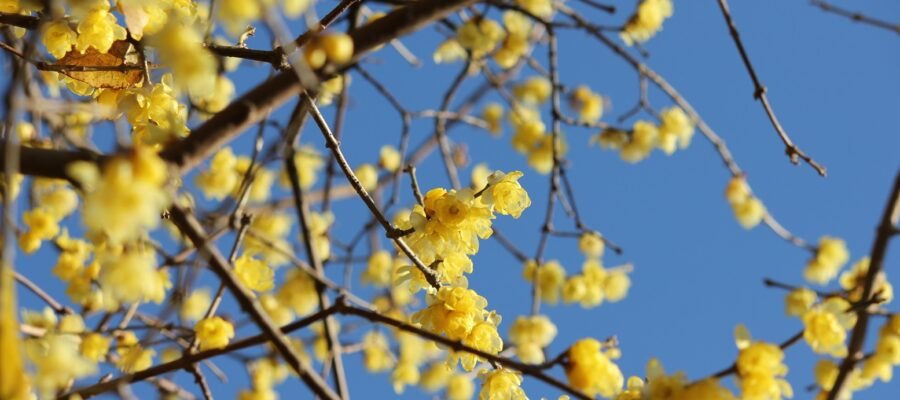
“Calicanto”—don’t you find the name poetic? It immediately evokes a song, a sweet melody floating in the air. Indeed, upon closer inspection, you’ll find that the tiny yellow Calicantho flower resembles a miniature sun, its light slightly concentrated at the center, as if announcing its awakening, even before winter has fully descended upon the city.
Yet, this yellow hue is so striking; a sun is a sun, even if it’s small. Therefore, the Calicantho flower always instantly captures people’s attention, attracting their gaze and awakening their senses of spring. But more importantly, its fragrance, like a rich aroma carried on the wind, heralds the approaching warm season.
Calicanto, the winter flower
Its botanical name is Chimonanthus praecoxa name that already contains the essence of this plant; in fact it derives from ancient Greek cheimon And anthosterms meaning respectively winter And flowerwhile with early we are referring to the precociousness with which its flowers bloom.
The family it belongs to is that of the calycanthaceae and its geographical origins are found in Sichuan, a region in south-west China. As further proof of its strength, know that this plant grows up to 3,000 meters above sea level!
The Calicanto, a medium-sized ornamental shrub (can grow up to 3m), it is an outdoor plant capable of resisting temperatures up to -12°, between January and February it flowers, spreading an intense scent throughout the surrounding areain summer it is covered with green foliage, rough to the touch, dense and lush while in autumn the leaves take on a golden hue.
Care and cultivation of Calicantus
Calicanto is a truly beautiful plant, capable of brightening the garden during the winter periods and embellishing it with its foliage during the warmer months. It is strong and resistant but this does not mean that it is not necessary to take some precautions so that it can grow (and/or continue to grow) in the best possible way!
Where to place the Calycanthus?
Choosing where to place the plant is certainly the first step towards achieving perfect development! For example, in In winter the flowers will bloom more abundantly if the plant is in full sun and sheltered from the wind. Bear in mind that although the calicanto is resistant, its flowers are rather delicate, they come off easily and once they fall they lose their scent very quickly, it is therefore important to prevent the wind from reaching them. During the summer months, however, he prefers to be in the area of half shade.
The ideal soil for Calicantus
In general it feels good fertile and well-drained soils, but also tolerates clayey soils. However, it does not like excessively calcareous soils. I, as always, recommend the excellent One plus!
The ideal temperatures of Calicantus
As we have already said, the calicanto is a real one mountain man of low temperatures. It won’t lose its flowers even at -12°!
How much to water the Calicantus?
Watering is not a difficult topic for Calicanto, in fact the plant will need to be well watered only in the first years after planting or during long periods of drought during the summer. However, be careful not to create water stagnation.
How to fertilize Calicantus?
The ideal fertilization for Calicanto should be done towards the end of autumn with an organic fertilizer based on products such as humus, manure, manure, etc. In spring, especially in the first years of life, it is a good idea to proceed with mineral fertilization: you can use a specific fertilizer for slow-release flowering shrubs administered in March, June and September.
Calicantus pruning
Calicanto manages to flower quite soon after grafting (although in the first 4-6 years, flowering will not be particularly abundant), but it needs a long, hot summer for this process to be completed, so it is better not to prune the plant in summer if it really isn’t necessary. The best time to carry out these works is certainly in the month of March, once flowering is complete. However, calicanto is a plant that grows slowly, in fact it requires marginal pruning, useful only for removing dry or broken branches. Furthermore it would be good practice to leave as many branches as possible that are more than 2 years old as it will be on these that the flowers will bloom.
Propagating Calycanthus
The calicanto has 4 ways to reproduce, one depending on the period:
- Sow in late summer;
- Medium layering (i.e. rooting a branch still connected to the mother plant) in October;
- Division of suckers in Spring;
- Cutting in the early autumn months.
Pests and diseases of Calicantus
Calicanto can be attacked by aphids and, sometimes, also by mites and scale insects. Don’t worry! There are many products created to deal with these pitfalls, then in any case the Vivai le Georgiche team is ready to give you assistance.
The symbolism of Calicantus
As I mentioned before, the unique shape of the Calicanthus tree is reminiscent of the sun, bringing us a sense of security and warmth. You might find it hard to believe, but I specifically researched the origins of the Calicanthus tree to write this article. At the time of writing this introduction, I knew nothing about the legends surrounding it.
It symbolizes how plants carry echoes of the past, beliefs, and myths. Despite the passage of time and the countless dramatic changes modern society has undergone, information and emotions remain rooted in its branches and leaves, as if we can rediscover ourselves among the leaves or petals. This refers not only to us as individuals, but also to us as a whole; we exist within us as vividly as our ancestors’ past, their beliefs, and principles, long before we possessed consciousness and logic—a gift we were born with.
However, let’s put that aside for now! You might now be wondering what the legends associated with the Calicanthus are; we’ll tell you later.
On a cold winter day, a robin was flying breathless and exhausted by the cold, looking for a shelter where he could regain his strength. The trees he found on his path, however, did not help him, jealous of the little that winter had left him. So, now exhausted, he arrived among the branches of the calicanto.
The calicanto with the last leaves it had left tried to warm the little robin, giving him comfort. The Lord, struck by such a gesture full of kindness, made a shower of brilliant stars with an intoxicating scent fall on the plant, which remained embedded in the branches, turning into small shiny flowers. From that day on, the calicanto blooms during the winter, bringing comfort and brightening up the gardens.
The Calicanto of the Georgics
Here in the nursery we take care of two varieties of calicanto: Florid Calicanto (Calicanto di Tenuta) and the Calicanto precox (Winter Calicanto). Del Winter Calicanto We have already talked about it extensively, so let’s take a quick look at it Calicanto di Tenutaafter all, we won’t be in his best period, but it’s worth knowing something more about him too!
Calycanthus Floridus is a shrub with thick, green, long and oval foliage. It reaches up to 2m in height and 2m in diameter. Around June-July it produces beautiful flowers of about 5cm, red-brown at the ends of the branches. In short, sticking to the legend, if in winter we find the intense yellow of the stars shining in the night, in summer, on this plant, we can admire a magnificent sunrise! We will have the opportunity to get to know this better in the next articles.
Calicanto (especially in winter) is a symbol of loving protection due to its legends. A sprig of Calicanto makes a perfect gift to express support. More importantly, its captivating fragrance makes it a base note in many perfumes. Folklore suggests it can awaken the body and mind dormant in winter. Therefore, in the cold months, try spraying some Calicanto perfume to strengthen your bones and nerves. The latter might seem more like superstition, but why not give it a try? At worst, you’ll exude the alluring scent of Calicanto!
Here are all the important characteristics of this wonderful plant! If you, like in the poems, can’t wait to see a fragrant, snowdrop-adorned flower, then Calicanto is the perfect choice for you.