
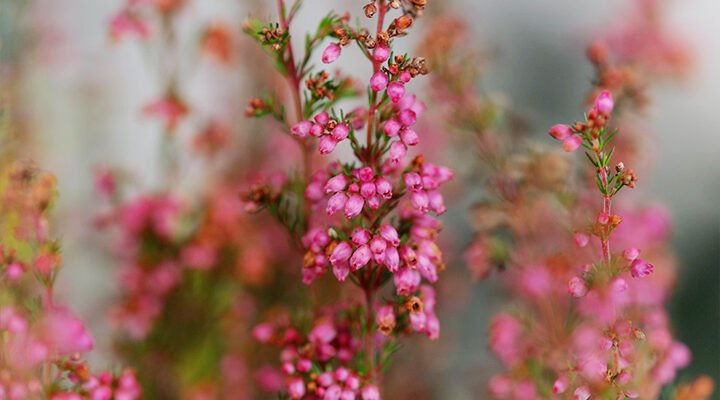
Heather is an evergreen, brightly colored, vigorous, and easy-to-care-for shrub. Even in the colder months when other plants rarely display similar colors, its flowers can add a splash of color to the garden.
Heather is well-suited for small gardens or potted plants, and when planted in large groups, it creates a visual feast of colors that change with the seasons.
Heather care
Erica is a rather large genus of plants and there may be some quite significant differences between one species and another when it comes to the care they need. In this article we will mainly look at the three main species: E. arborea, E. gracilis and E. x darleyensis.
What exposure to give to Erica
Exposure is one of the parameters for which it is necessary to make a distinction between the 3 species:
- E. arborea: sunny;
- E. gracilis: sunny, partial shade;
- E. x darleyensis: sunny, partial shade. They are plants vulnerable to the intense heat of summer, so it is better to have the possibility of moving them to an area with shielded light.
What temperature does Erica want?
The ideal temperature ranges from 7 to 15°C. Specifically:
- E. arborea: resists down to -10°C;
- E. gracilis: it does not like frost, it is therefore advisable not to expose it to temperatures below zero;
- E. x darleyensis: up to -10/-15°C.
How to water Heather
Once established they are plants that they resist drought quite wellbetter to wait until the soil is dry before proceeding with the next wetting.
It is recommended use lime-free water (better to use rainwater or demineralised water).
Which substrate to choose for Erica
The ideal terrain is fresh, light, well drained, with little moisture retention and with a neutral to acidic pH. A great way to keep acidity high is to mulch with composted pine needles or use a special product.
Recommended: One, One+, soil for acidophilic plants.
Avoid damp or chalky soils. In general they are plants that adapt to poor soil.
How to fertilize Erica
During the growth months, give liquid fertilizer for acidophilic plants combined with the wetting water.
When to repot Erica
The Erica would go repotted every year: once flowering is over, you can move the plant into a pot slightly larger than the previous one.
How to propagate Erica
The main method of propagation of Erica is by cutting taken in early spring or at the end of summer. Or you can proceed with the division of the tufts in autumn.
How and when to prune Erica
When pruning photinia (ideally after flowering), it’s crucial to remember that old, woody branches are difficult for photinia to recover. Many small shrubs, such as lavender, photinia, and wild photinia, have relatively short lifespans and need replacement approximately every 10 years. Since these shrubs flower on new shoots, annual pruning promotes flowering, extends their lifespan, and prevents excessive wooding of the branches.
Heather parasites and diseases
Erica is very resistant to parasites and diseasesalthough it can sometimes be attacked by red spider mites, it is vulnerable to root rot, which is why it is essential to provide well-draining soil.
We know Erica
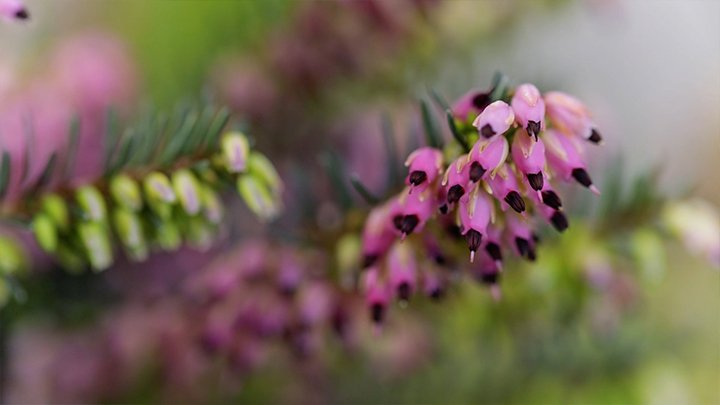
Photinia flowers produce small, bell-shaped or tubular blossoms in pink, purple, red, or white, with varying blooming periods depending on the variety. Despite their small size, the flowers grow very densely, sometimes obscuring the foliage.
The slender, needle-like evergreen leaves display various shades of green and yellow with a coppery sheen, adding further color to the garden.
In gardens, photinia is traditionally used as ground cover, hedges, or winter bedding. It typically grows to a height of 20 cm to 1.5 meters.
Photinia is a rich source of nectar and pollen for bees and other pollinating insects.
While photinia is similar to common photinia (Calluna), the two differ in many ways: blooming period, flower shape, and leaf shape. Common photinia is a marsh plant, thus adapted to perpetually moist environments, while photinia thrives even in dry soil. Direct comparison makes it easier to identify the unique characteristics of these two species.
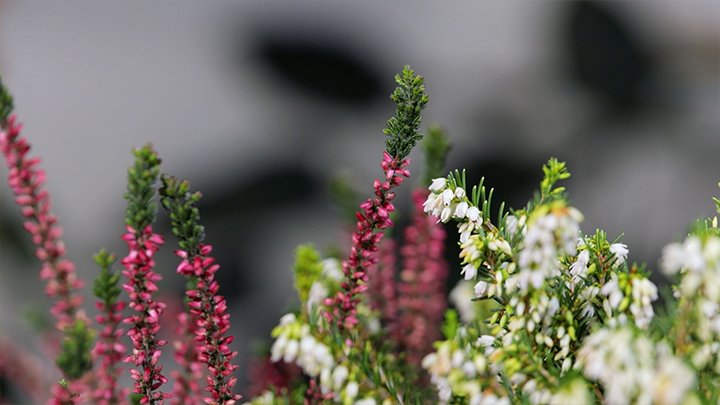
Let’s look at some characteristics of the Erica species:
Tree heather: it takes this name because it develops a tree that in nature reaches 7 meters within 5-10 years. The Albert’s Gold that we have in the nursery does not exceed one and a half meters, two meters maximum in 10 years of growth. It is a plant that we often find in the Mediterranean basin area, in Africa but also at equatorial latitudes.
THE flowering is springdiffering a bit in terms of age from the other Ericas. The flowers are white and fragrant, surrounded by dark green leaves.
Erica gracile: it is a compact plant that tends to never exceed 40-60cm tallits flowering is quite extensive and goes from autumn to spring, assuming deep pink shade.
Erica x darleyensis: they are the most common to find on the market, they are very compact and never exceed 50-60 cm which they reach in about 5-10 years. The leaf is evergreen and the color of the flower depends on the cultivar, varying in shades of pink, white and purple. They flower from winter to spring.
Taxonomic description
It is part of the family of Ericaceaethis family has around 850 evergreen shrubby species.
Habitat
The habitat varies from species to species, mostly divided between South Africa and Europe. In Italy you can find about 8 spontaneous ones.
Curiosity
In Scotland Heather is considered a lucky charmso much so that at weddings it is usual to give white heather as a wish for a happy marriage.
Erica from Vivai le Georgiche
Here at Vivai le Georgiche we are lucky enough to host some Ericas, here they are!
- Erica arborea “Alberto’s gold”
small evergreen shrub with an upright habit, which develops golden leaves and bell-shaped flowers, scented with honeygreyish-white in colour, 4 mm long and collected in leafy pyramidal racemes, 20-40 cm long, which bloom in spring. It can reach about 2 m in height in 10-20 years. - Erica gracile
small evergreen shrub with a compact habit, which develops small linear, dark green leaves and numerous bell-shaped flowers, 4 mm long, of medium pink colorgathered in number of 4 in whorls 1 cm long, which bloom from autumn to spring. It can reach a height of about 50 cm in 1-2 years. - Erica x darleyensis “Darley Dale”
small evergreen shrub with lanceolate, slightly fleshy green leaves, with cream-coloured tips in spring. From December to April it develops numerous flowers, from urceolate to cylindrical, of pinkish-yellowish colourwhich over time take on a darker shade, 5 mm long, collected in 10 cm long racemes. It can reach approximately 45 cm in height. - Erica x darleyensis “Kramer’s Rote”
small evergreen shrub with lanceolate, slightly fleshy, bronze-green leaves. From December to April it develops numerous flowers, from urceolate to cylindrical, of magenta color5 mm long, collected in 10 cm long racemes. It can reach approximately 60 cm in height. - Erica x darleyensis “White Perfection”
small evergreen shrub with lanceolate, slightly fleshy green leaves. From December to April it develops numerous flowers, from urceolate to cylindrical, pure white in colour, 5 mm long, collected in racemes 10 cm long. It can reach approximately 40 cm in height.