
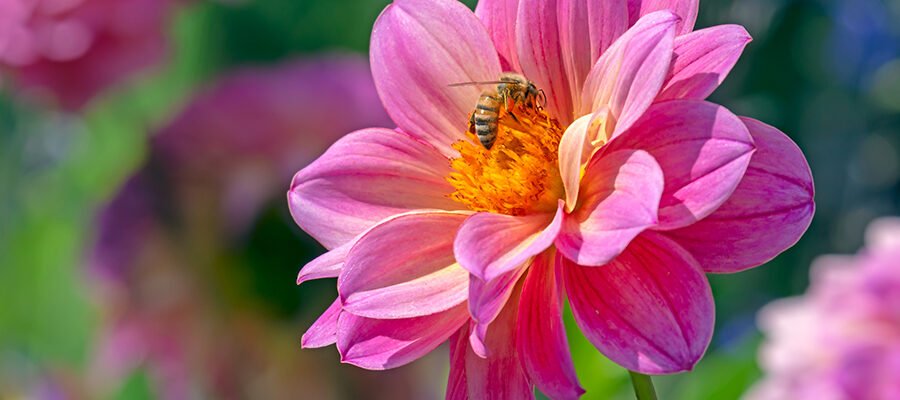
While we’re still admiring the beautiful blooms of the bulbous flowers we carefully planted last autumn, it’s time to consider summer-flowering bulbs. Today we’re talking about dahlias, with their diverse shapes and vibrant colors, creating a stunning sea of blossoms from summer to autumn—truly unique.
They complement other late-blooming plants like ornamental sage and other ornamental grasses, adding vibrant color to the garden and perfectly matching the season’s atmosphere. Dahlias are suitable for both potted plants and cut flowers.
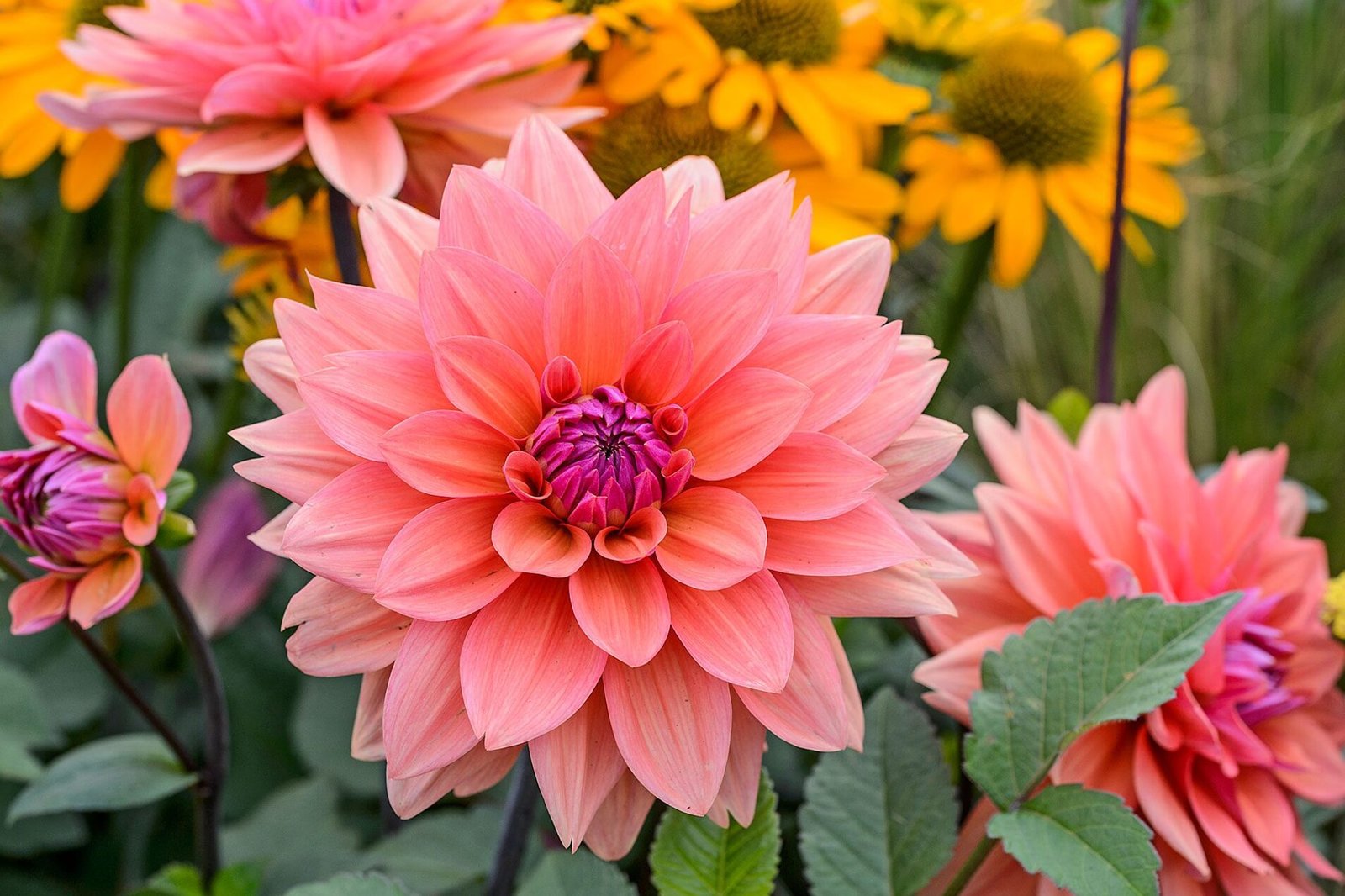
Care and cultivation of Dahlias
Planting dahlia bulbs
As I show in the video it is possible to start by inserting the bulb into the vase, carrying out a single watering until growth starts.
Or you can choose to start directly by placing the bulb in the ground in April, after the last frosts.
It is likely that when you become collectors or PRO level Dalia lovers, you will come across highly sought after varieties offered as rooted cuttings. The seeds, however, are usually sold in miscellany and are most often used in compact varieties to cover flowerbeds.
What exposure to give to the Dahlia
Usually these flowers they love warm, sunny and sheltered positions. Instead, it is better to avoid shade, as well as cold, damp soil and very dry places.
What is the ideal temperature for Dahlias?
They are perennial plants that observe a period of quiescence in the cold seasonuntil their vegetation is eliminated for overwintering at tuber level, but even in this form it would be better, in areas with harsh winters, to extract them from the ground once they have gone to rest and clean the tubers to place them in a cool, dry area protected from frost.
How much water to give dahlias
Dahlias prefer a moist soil. They are plants that love to drink, so it is important to water abundantly and rather frequently, especially during the summer months.
The ideal substrate for Dahlias
Dahlias grow well in open ground, however leaving about 50-60 cm between one plant and another, even more for the taller cultivars.
They love fertile and drained soils, they suffer in dry soils and on the contrary where there is water stagnation (rot). As always, I recommend One plus 😉
If you have heavy soil I recommend dig some sandbetter in late autumn, also incorporating organic substance.
In light soils, Dahlias have a better chance of surviving outdoors all year round without being uprooted because the earth soaks up less and the temperatures, even if a little lower, don’t bother them.
In recent years, mild winters have allowed mulched dahlias to survive in the soil and bloom early. This low-maintenance option can be risky in harsh winters. You can leave dahlias in the ground and protect them with a thick mulch that you will remove after spring frosts. Wait until the dahlias are blackened by the first autumn frosts, then cut them 10 cm from the ground and place a pile of mulch on each plant to protect them over the winter.
Fertilize Dahlias
I propose some fertilizers that can be good for Dahlias:
- liquid fertilizer for Cifo flowering plants;
- Asso di Fiori, even better if combined with Bio Oro;
- Cifo slow release fertilizer for flowering plants.
Dahlia parasites
One of the biggest enemies of dahlias is slugs and snails. To control slugs and snails, I recommend using lime powder (Lithotamnium), a fertilizer made from sediment powder. It effectively repels and interferes with the feeding activities of caterpillars, slugs, and bedbugs, thus forming a barrier.
Another disease that harms dahlias is powdery mildew. The treatment is to dissolve the following agent in 100 ml of water:
To prevent powdery mildew, I recommend using propolis.
Tutoring Dahlias
Dahlias need to be supported by a stake as they grow. Don’t forget to carefully wrap their stems every fourteen days. These lush flowers they develop with surprising rapidity when they are encouraged and can easily be overwhelmed by bad weather if they are not firmly anchored to the ground.
Pruning Dahlias
Thinning of stems
Dahlias, with their vitality, can develop dense stems which need to be thinned during the summer months. I advise you to intervene in June or July to improve the general appearance of the plant.
It is advisable to maintain seven to ten sturdy stems for each plant.
Carefully select the thin or too thick shoots that you want to eliminate: apply light pressure to detach them.
For large-flowered Dahlias, limit the number of stems to three or five per plant to encourage the production of fewer but more impressive flowers.
Dahlia deadheading
If you decide to leave some Dahlia flowers in the garden, it is important to practice a Regular pruning to promote prolonged flowering. To remove wilted flowers, follow the stem to the base and cut above the first pair of leaves you come across.
Trimming the Dahlia
When the main stem reaches about 40 centimeters in height, you can encourage the plant to branch out to encourage growth denser growth and more abundant flower production. Just gently pinch the tip of the stem right above a couple of leaves. This will stimulate the formation of new lateral shoots, contributing to greater plant density.
Propagating Dahlias
The propagation of Dahlias can occur in two ways:
- through the division of tubers;
- or for tell the women: In spring, once the tuber shoots have emerged, select sturdy, healthy ones that measure approximately 7.5cm in length. Cut them carefully using a clean, sharp knife, leaving a small part of the mother tuber attached to the sprout. Remove all the leaves except the top two and lightly pinch their ends. Prepare a one-liter pot by filling it with a mixture of compost and sand. Place each shoot on the edge of the pot, with the leaves slightly above the level of the compost and keeping them spaced apart so that they do not touch. Pour water from above to compact the compost. Then, place the pot in a bright, warm place, but avoid direct sunlight. Transplant into open ground towards the end of April or beginning of May.
Common Dahlia Problems
Why don’t my Dahlia tubers sprout?
We often make the mistake of watering newly planted tubers too muchwhich can cause it to rot. After planting the tuber for the first time, water the soil only once and then wait for the first shoots to appear before watering again.
Why is my Dahlia wilting?
Growing Dahlias can have a great need for water, especially when they are in full growth. Make sure the ground around them is constantly humid. You may need to water every few days, especially during dry periods.
Why are my dahlias so short?
Some varieties of Dahlias can be very compactthen check the information on the seed packaging (or on the relevant product page on our website) to find out the final dimensions of the plant. If growth seems slow, it could be due to environmental conditions: cold temperatures or late frosts can affect growth. Make sure the Dahlias are placed in a sunny location.
Frequently asked questions about Dahlias
How big do dahlias grow?
It really depends on the type of variety chosen, there are compact varieties around 40 cm tall, as well as varieties that reach over 1.5 m 😉
When do dahlias start sprouting?
Tubers planted in early spring will begin to sprout after about 2-3 weeks.
Let’s get to know Dahlias
Dahlias are found within the large asteraceae family, characterized by a very “daisy” appearance, thanks to the flower heads that they create.
They are perennial from tuber-like rootswhich are usually planted in spring, when temperatures rise.
The morphology of the flower, as I was saying, is variable, ranging from approximately 5 to 30 cm in some cases and covering colors from pastel shades up to intense and vibrant tones. The height of the plant can also vary greatly depending on the variety, ranging from 30 cm up to 150-200 cm and more.
Based on these characteristics it is usual to classify them into homogeneous groups, especially for the shape of the flower and therefore we have single-flowered and complex-flowered Dahlias, cactus Dahlias with sunburst petals, pompom-shaped ones and many others!
If you become passionate about them you will see that there is a huge world to explore. In the meantime, on the shop you will find a selection of beautiful varieties with which, in my opinion, you can easily start and they are in excellent company because there are all the other bulbous/rhizomatous/tuberous varieties that can be planted in the coming weeks.
Native to Central America and Mexico, dahlias are tender perennials, meaning they can live for many years, but need protection from freezing temperatures. They grow from underground tubers, with the top part dying in the winter and sprouting again in the spring.