
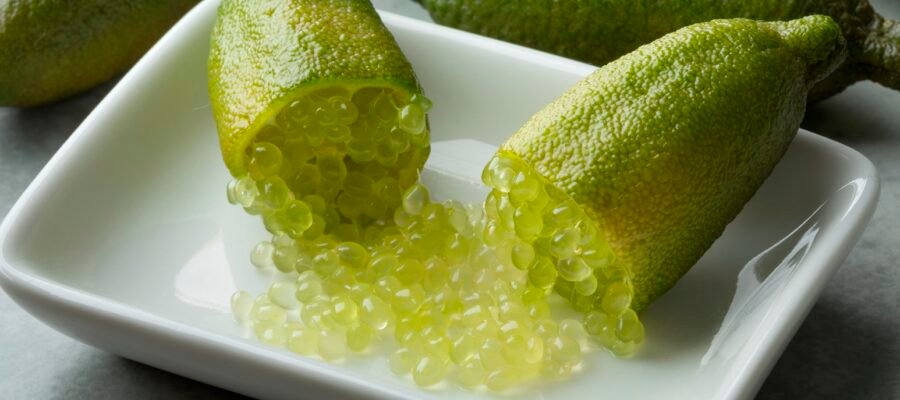
The Citrus Australasica or Finger Lime plant is a perennial and evergreen fruit tree, native to Australia, it belongs to the Rutaceae family and in Italy it is called Lemon Caviar. In Australia it lives in a narrow coastal area where the subtropical forest grows, in a climate where constant heat and regular rainfall reigns.
Here you can find different qualities of Lemon Caviar!
It is a shrub that does not exceed 6 meters in height and has a habit very bushy.
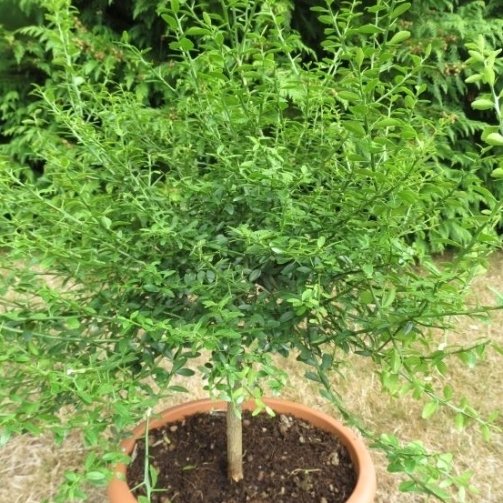
The foliage is thick and small, they are simple and oval and when rubbed they give off a citrus scent. Under the axils of the leaves there are straight and pointed thorns that reach 4 cm.
The small flowers bloom from June to October, they are solitary and numerous and made up of 3 white or pale pink petals.
Its fruits begin to ripen from December to May, peaking between March and May, they have a cylindrical and elongated shape, with thin and wrinkled skin, with a shiny appearance due to the numerous glands that contain oil, they reach a length of 6-7 cm and a diameter of 2-2.5 cm.

When the fruit is opened it has 3 to 6 long cavities that contain small spheres, resembling pearls, full of a succulent liquid with a taste similar to lemon and grapefruit, which can be extracted with a spoon, these resemble caviar in size and consistency! The varieties on the market in Italy are selected hybrids with few seeds and a different range of pulp colors: green, white, yellow, purple, pink and bright red. Attention: the fruit does not ripen if separated from the plant but must be picked when it is completely ripe, detaching it with a slight twist from the plant. The fruit keeps well for 4-5 weeks at 5-10°C, while the pulp can be frozen for many months without losing its taste.
It is much appreciated by chefs as a decorative element in the preparation of dishes, ideal for accompanying fish, oysters or salmon and desserts.

Inside a plantation the distance from tree to tree is approximately 2.5-3 m while the distance between rows is 4-5 m to facilitate fruit harvesting.
EXPOSURE: It is a plant that likes a lot of light but not direct exposure, except for a few hours of the day.
TEMPERATURE: it is a plant that can live in Italy but in the northern areas it needs to be grown in a pot to protect it from the winter cold, bringing it to an unheated and bright area, where the foliage can possibly be covered with TNT (non-woven fabric) and with mulch at the roots.
TERRAIN: the soil must be well drained to avoid root rot, preferably neutral or sub-acid.
WATERFALL: in summer it should be watered abundantly, paying attention to stagnation.

FERTILIZER: generally the caviar lemon must be fertilized from April to September every 15 days, with water from watering. It should be done with a fertilizer rich in potassium to enhance the flavor of the fruits.
PRUNING: the caviar lemon should be pruned little, it serves to improve air circulation and the quality of the fruit, in fact by removing some branches the rubbing between the thorns and the fruits which often damages the latter is reduced. For breeding pruning, 4-6 branches should be maintained. Suckers must be eliminated.
PLANTING: for potted plants, planting can be done at any time of the year.
PLAYBACK: his is not recommended reproduction by seed, since the resulting plants differ very much from the mother plant. The “finger lime” tolerates grafting very well.
PARASITES AND DISEASES: Lemon caviar, like all citrus fruits, can be attacked by numerous animal parasites such as aphids, citrus thrips, mites, scale insects and moniliosis. Among the plant parasites we find root rot, dry disease and gummy canker.
PROPERTY: This citrus fruit has refreshing, diuretic, antiseptic properties and aids digestion. Contains vitamins C and B6, folic acid and potassium.