
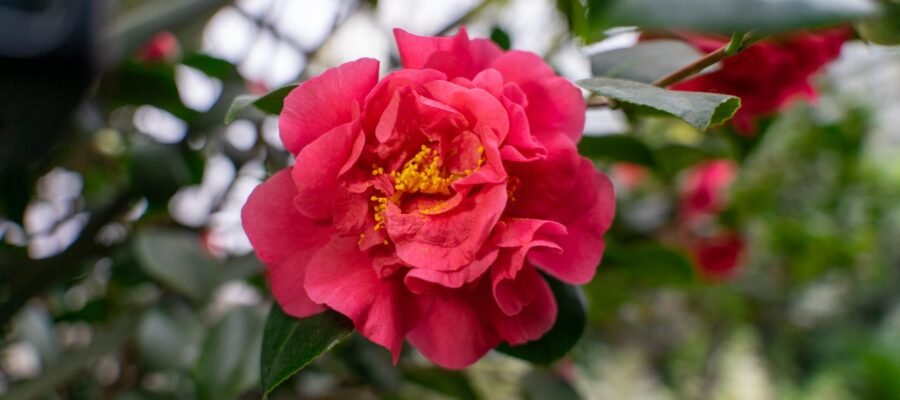
The petals are large and colourful, arranged neatly and symmetrically around a bright yellow centre. They move back and forth, in step with the currents, they dance on the snow and stand out in the white, proudly raising their heads. Ladies and gentlemen, today we are pleased to present to you, on our blog, the enchanting camellia sasanqua!
This delicate flower comes directly from the land of the Rising Sun. In fact, looking at it, the imagination could almost see in the camellia sasanqua moved by the wind a young Maiko, an apprentice geisha; with a pale face, red lips and a brightly colored kimono. Maiko in Japanese means “dancing girl” and if we in the West are barred from these wonders that have always characterized distant countries, we are still allowed to admire the flowers that come from there, grow them and see fascinating and mysterious cultures flourish in them.
We just can’t get this image out of our heads. The thin petals of the camellia sasanqua, tinged with intense pink or white, the delicious but discreet scent, the slender figure that faces the harshness of winter with incredible elegance. Precisely a flower that carries its birthplace within itself, that still wants to talk about its country of origin, to tell us and the rest of the world about the vibrations of ancient Japan.
Camellia sasanqua, a winter plant
The camellia sasanqua is just one of the various genera of camellias that we can easily find around the city, but it has proven to have something particular: a strong resistance to the type of soil and climate. Furthermore, its identifying characteristic can be found in flowering, in fact this occurs in the autumn and winter season, more or less from November to March (depending on the area we are in). Another important point is its long life which alternates very abundant blooms with slightly more sparse blooms.
Being an evergreen, in the months during which it remains without flowers, the camellia sasanqua does not lose its decorative value, maintaining its beautiful green leaves.
Growing Camellia sasanqua
The camellia sasanqua is a particular camellia that begins its flowering during the winter months, this already says a lot about its ability to adapt and its resistance. They are suitable for pruning and do well if used for flowerbeds or hedges (in this case with a distance between one and the other of at least 80-100cm), or if made to climb a structure. Finally, if you don’t have a garden don’t worry, Camellia sasanqua can also be grown in potsperhaps with the foresight of choosing the variety with the slowest and most compact growth. Consequently, cultivating it will not be a big problem, but, as always, it is necessary to pay attention to some guidelines, especially regarding the type of soil.
EXPOSURE
As you can imagine by now, the sasanqua camellia adapts quite well, but It doesn’t like too hot climates. In winter, however, it defends itself better even though it is not at ease even with the extremes of cold, in particular She doesn’t like strong winds and snowso it would be really ideal if there were elements around it (such as, for example, other plants) that could shelter it.
In general it loves shaded areas, without disdaining occasional exposure to direct sunlight.
TEMPERATURE
The camellia sasanqua has particularly thin but resistant leaves that allow it to hold on during the winter cold, managing to withstand temperatures down to -10°C. However, it is important that the roots are never in contact with frost.
LAND
For these flowers you need a fresh and well-drained soil, not calcareous but rich in organic substances and, even better, with an acidic or neutral pH. If you wish to place it in a spot where the soil is poorly draining (such as clayey soil), the ideal would be to create a rather large hole in order to mix the clay already present with peat, compost, mature manure and, finally, leaf mould.
IRRIGATION
The camellia sasanqua, in summer, should be watered in the evening and with lots of water, sprayed directly on the leaves. It’s really important avoid water stagnation which could lead to root asphyxiation. In general, to know if the plant needs to drink, it is sufficient to make sure that the first 5cm of the soil layer is dry.
FERTILIZATION
Fertilization is not required constantly, but rather it must be done only when the plant feels the need for it in spring and autumn. Another solution is to not fertilize but to apply a mulch based on material of plant origin and compost which will act as a protective blanket for the plant during the cold winter months.
REPRODUCTION
This shrub can reproduce towards the end of summer until the end of winter and it is possible to do it in two ways: by cutting or through leaf buds.
PRUNING
Pruning them allows them to grow in an orderly manner while maintaining the balance of the foliage. Pruning the camellia sasanqua is not difficult, as it is well disposed towards this type of maintenance. Another necessary operation could be to eliminate dry or damaged branches, in order to lighten the plant a little from its load.
REPOT
Repotting the camellia sasanqua must be done during the flowering period, you will have to give up some buds that will fall during the operation, but the plant will be better able to withstand the change. However, we are very careful to damage the roots as little as possible.
PITFALLS
The camellia sasanqua does not like snow falling on its leaves, this is because it represents a source of danger for it, as the intense prolonged cold could cause burns and damage to the buds and flowers. As for parasites, its enemies are represented by aphids and cochineal (both visible to the naked eye, they cause dark spots on the foliage which becomes sticky shortly after). For every problem there is a remedy, if something is affecting your plant contact us on our official social networks, we will be happy to help you!
MOUNTAIN TEA FLOWER
As we have already said, the camellia sasanqua is native to Japan, where it is called “sazankwa” which literally means “mountain tea flower”.
His family belongs to the Theaceaewhich in turn includes around 250 species, all native to China, Japan and Korea.
Camellia sasanqua is a small shrub evergreen which reaches maximum dimensions of approximately 3-5m in height.
This flower probably arrived in Europe in the mid-1700s, although confirmation only came in 1789, when the camellia sasanqua arrived in England thanks to Charles Maries. Only much later did it manage to reach Italian lands, brought by nobles who bought houses on the shores of the northern lakes. This shrub was then transformed and subjected to experiments by hybridizers who wanted to try to create new varieties, as it is both a very resistant flower and has the advantage of having flowering in a period in which most of the others do not yet think about blooming (between October and March). The work of the hybridizers was successful, giving life to many varieties, but we must also take into account that nature itself already does an excellent job in this field, so there are different combinations born in a completely natural way. For example, it’s fascinating to think that Camellia Sinensis is not only the well-known tea plant and a beautiful ornamental, but it is also a natural variety of sasanqua!
CAMELLIAS FROM THE LE GEORGICHE NURSERY
In our nursery we are happy to host some of the camellia sasanqua varieties. We remind you that all these camellias are grown for their elegant foliage and the profusion of their flowers. Furthermore, they are ideal for borders or woodland gardens or as isolated specimens in the ground or in pots. In common they have foliage with lateral margins slightly bent downwards, flowering from October to December, resistance to temperatures below 0 and dimensions that can reach up to 3m in height and 2m in width.
Here we are, we have learned all the secrets of the dance of this enchanting flower. Are you looking for a touch of color that breaks the monotony of winter a little? You found it!