
Did you think you survived? Did you feel like you’d won a personal victory after reading that article about wild garlic? Even felt safe?
Sorry, not quite. Last week, we gave you a fright with those terrifying belladonna and prickly apples—perfect for Halloween, after all.
But now that you’ve relaxed a bit, we have another topic for you, guaranteed to make you regret last week’s “fright.”
Welcome to Halloween Week after Halloween!
Thanks to everyone who persevered and read through our “little joke”: today, we’re talking about universally loved wild garlic!
Those who consider garlic their mortal enemy—are you ready for the challenge? And for those who love garlic and its close relatives, are you ready to explore a whole new delicious variety?
Alright, let’s begin!
AGLIONE
From the name it seems like just a very large garlic. But is it really like that? Absolutely not.
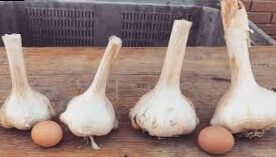
Aglione is a typical variety of the Tuscan tradition, in particular of the Valdichiana. The name already suggests its larger size compared to common garlic, in fact it reaches 800g. of weight. Be careful though, garlic also differs in flavour, it is in fact much more delicate than its other close relatives.
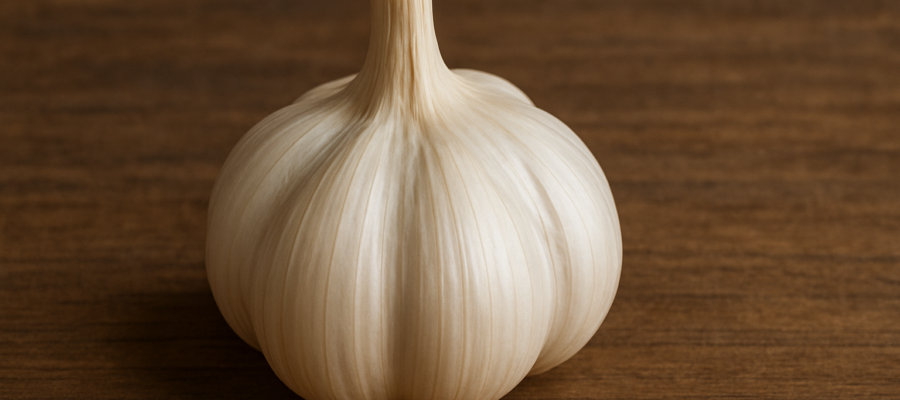
Its shape is extremely recognizable: almost spherical and slightly flattened at the poles. Inside there are 6 bulbils, separate and large. The color is ivory white, without any nuance.
ALLIUM AMPELOPRASUS
Allium ampeloprasum is the botanical name of aglione. It is immediately clear that it is part of the allium genus, from which both common garlic and wild garlic originate.
While the family is that of Liliaceae.
LOVER’S GARLIC
Since the beginning of the world we know that if you go out for dinner with your girlfriend/boyfriend, it is definitely better to avoid eating garlic.
Otherwise, whether your partner likes garlic or not, you risk being sent away without any possibility of appeal. It’s definitely not nice to look like that.
Yet you wanted to be splendid with your sweetheart, going to that special little place where they make the best bruschetta in the whole area and you just don’t want to give up? Well, great news! If you read on the menu that bruschetta is made with garlic, you can eat it with complete peace of mind.
In fact, Aglione does not contain allin and this not only makes it more digestible but it also won’t leave that unpleasant smell.
AN ENDANGERED TREASURE
Agriona garlic was once widely popular, but unfortunately, its cultivation has almost completely ceased in recent years. This has led to a sharp decline in its production, almost to the point of extinction, and it is now considered a niche product.
Thanks to the Slow Food Association of Tuscany and the Slow Food Association of Montepulciano-Chiusi listing Agriona garlic as the first protected species, it is gradually regaining attention and becoming a representative of traditional Italian, especially Tuscan, cuisine once again.
According to a ministerial decree of May 23, 2016, Valdigiana garlic was included in the regional and national register of traditional agricultural products.
To understand the significance of this recognition, one only needs to look at the criteria for inclusion in the register of traditional agricultural products: processing, preservation, and aging must employ traditional methods consistent throughout the region and must adhere to traditional rules for at least 25 years.
TAKING CARE OF YOUR AGLIONE
Taking care of the aglione is not particularly difficult, in fact you just need to take note of some simple precautions
TEMPERATURE
It loves mild temperatures but can also tolerate slightly harsher climates.
PLACING
The right period to plant the garlic bulb is from mid-October until the first half of November. The bulbs should be placed about 3cm deep and at a distance that can vary from 20 to 30cm, but for more information we refer you to the article on how to plant the bulbs.
After planting it is necessary to pay attention to the weeds which must be eradicated with a certain regularity.
IRRIGATIONS
The soil, especially in depth, must always preserve moisture. This plant does not need to be watered, in fact it manages to make the most of the rain! Of course, however, if in the months of May and June the temperatures are particularly high then it is better to water the soil every now and then and in moderation, this is the moment in which the bulb grows, we certainly don’t want it to remain dry.
LAND
The ground must be right loose, sandy and absolutely structured to avoid water stagnation which could cause rot. In spring it must be kept clean of weeds and this intervention is taken advantage of by hoeing the soil surrounding the plant.
FERTILIZATIONS
Aglione only requires mineral fertilizers and never organic ones as this would increase the possibility of rotting developing.
FLOWERING
In summer it gives life to delicate spherical blooms in shades of purple. Despite the beauty of these little flowers, when the plant reaches about 20cm in height it is advisable to remove it in order to prevent energy from being spent on the production of flowers and not on the swelling of the bulb.
HARVEST
The Aglione must be harvested during the summer of the following year, when the vegetation begins to yellow. We remind you that before putting away your loot, it is necessary to let it dry in a dark and well-ventilated environment, this way it will last much longer.
BENEFICIAL PROPERTIES
Aglione, like any self-respecting garlic, can boast a series of beneficial properties for the body. Let’s look at the basics right away!
- Lowers blood sugar;
- Keeps the intestine clean;
- It has antioxidant properties;
- It has a high mineral content (calcium, phosphorus, potassium and magnesium).
AGLIONE IN THE KITCHEN
As we mentioned before, garlic lends itself perfectly to being a highly respectable ingredient in our kitchens. Its versatility is admirable but, if you really want to experience the thrill of preparing one of the most typical dishes yourself, we can’t help but tell you about the pici all’aglioneprecisely characterized by the use of garlic. Prepare a sauce by placing garlic cloves, white wine and oil in a pan. When the garlic takes on the consistency of a cream, add chopped tomatoes and mix until the sauce reaches the desired density.
CURIOSITY
Traces of garlic were discovered at the Palace of Knossos on the Greek island of Crete. Even the ancients recognized its precious value!
We embarked on a journey to explore the world of garlic. While garlic is still relatively unknown, it undoubtedly possesses all the potential to become a more widely recognized and acclaimed product.
Garlic is a specialty of the Valdikiana region, not only healthy and delicious but also enriching the traditional culture of this magnificent valley!