
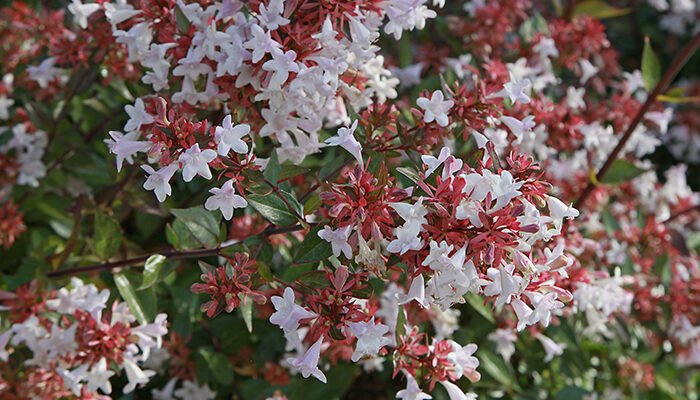
Are you looking for a beautiful shrub that’s pleasing to the eye from summer to autumn? Then the Six-Leaf Tree is exactly what you need!
The Six-Leaf Tree is an evergreen shrub that’s highly adaptable and can grow in almost any soil type. Even after its flowering season, its lush foliage and stamens still add a vibrant touch to your garden. 😉
Furthermore, this plant attracts hummingbirds, butterflies, and other pollinating insects to collect nectar.
Abelia care
Abelia is a plant that is not too complex to grow, but it is necessary to pay attention to some aspects, in particular cold and dry winds! But let’s see everything in detail!
Abelia Exhibition
Abelia can be grown both in sunny areas and in partial shade. However, as is customary, planting it in more sunny areas will encourage more vibrant foliage colors and healthy flowering.
During the hottest seasons, in the afternoon hours, the ideal would be to temporarily move the plant to a more shaded area.
What temperatures does Abelia want?
Abelia is a rustic shrub but prefers to be sheltered from winter winds. Resists up to -15°C and has excellent heat resistance
How to water Abelia
It is a rather drought-resistant plant, especially in the warmer months but it is suitable water it regularlywaiting for the soil to start drying before proceeding with a second wetting.
In winter, reduce or suspend watering.
Which substrate to choose for Abelia
The Abelia needs a fertile, well-draining soil and humid, but in reality it also tolerates different conditions. It prefers a substrate with a slightly sub-acid pH.
In pots and planters they are excellent soils such as One and One+.
The ideal fertilization for Abelia
Fertilize with del slow release fertilizer for flowering shrubsperforming three surgeries in March, June and September. It is also advisable, before winter, to give organic fertilization.
Propagation of Abelia
Propagation of Abelia can be done through cuttingsbetter if made of soft wood in spring and hard wood in autumn.
Prune Abelia
It is recommended to prune shrubs from late autumn to early spring. Pruning is mainly carried out by removing damaged or dead branches and taking action maintain shape desired.
Abelia parasites and diseases
These plants are rarely affected by pests and diseases, but powdery mildew and aphids can cause them some problems.
To treat aphids we recommend an emergency mixture consisting of:
And a coverage mixture:
To treat powdery mildew we recommend an emergency mixture consisting of:
And a coverage mixture:
The most famous Abelia varieties
There are many varieties of Abelia, but let’s take a closer look at the best-known varieties:
- Abelia x grandiflora
Evergreen or semi-deciduous shrub, rounded with arched arms. It develops ovate leaves, of a beautiful shiny dark green colour, up to 5 cm long, white tubular flowers tinged with pinkvery fragrant, 2 cm long, which bloom from May to October.
It can reach a height of approximately 3 m and a width of 4 m. - Abelia x grandiflora “Compact” (dwarf)
Evergreen or semi-deciduous shrub, rounded, with arched branches and compact shape. It develops ovate leaves, of a beautiful shiny dark green colour, up to 5 cm long, white tubular flowers tinged with pinkvery fragrant, 2 cm long, which bloom from May to October.
It can reach a height of approximately 100 cm. - Abelia “Edward Goucher”
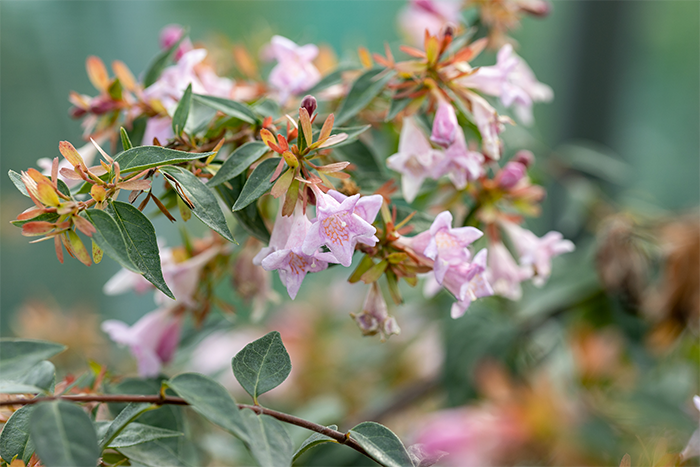
Semi-deciduous shrub, rounded, with arched branches. It develops ovate leaves, of a beautiful shiny dark green colour, up to 5 cm long, pink-lilac tubular flowersvery fragrant, 2 cm long, which bloom from May to October.
It can reach a height of approximately 1.5 m and a width of 2 m. - Abelia x grandiflora “Confetti”
Evergreen or semi-deciduous shrub, rounded, with arched branches. Develop leaves ovate of a beautiful color shiny dark green, edged with cream and pink in springup to 5 cm long, white tubular flowersvery fragrant, 2 cm long, which bloom from May to October.
It can reach a height of about 3 meters. - Abelia x grandiflora “Kaleidoscope”
Rounded evergreen or semi-deciduous shrub, with arched branches, which develops leaves ovate, of a beautiful yellow-green colour, subsequently turning orange-redup to 5 cm long, white tubular flowers tinged with pinkvery fragrant, 2 cm long.
It can reach a height of approximately 3 m. - Abelia x grandiflora “Prostrata”
Evergreen or deciduous shrub, with a trailing habit, with arched branches. It develops ovate leaves, of a beautiful shiny dark green colour, up to 5 cm long and white tubular flowers tinged with pinkvery fragrant, 2 cm long, which bloom from May to October.
It can reach a height of approximately 50cm.
Common Abelia problems
Foliage without flowers
Sometimes it can happen that Abelia has very lush foliage but no flowering. This problem could be a sign of the wrong fertilizer. Fertilizers with too much nitrogen encourage foliage growth rather than flower production, so it is advisable to choose one with a higher ratio of phosphorus, nitrogen and potassium to solve the problem.
Yellow leaves and unhealthy appearance
These symptoms are often caused by an excess of water in turn generated by soaked and poorly draining soil. The much feared root rot can therefore hide behind the yellow leaves.
In this case it is a good idea to check the state of the roots and if necessary eliminate the damaged ones, change the soil with a more draining one and let the soil dry more between future wetting.
Description
Six-lobed wood has glossy leaves and produces numerous pink, white, or cherry-red tubular flowers. The leaves display a rich variety of hues; some varieties have golden or mottled leaves, and the color changes with the seasons. Leaves are typically opposite and 1.5 to 8 cm long.
After flowering, most varieties retain their brightly colored sepals, which, along with the leaves, add a vibrant touch to autumn.
They are shrubs, typically growing to 1 to 6 meters tall.
Note: Not all six-lobed wood varieties are evergreen; some are deciduous. Six-lobed wood shrubs growing in cooler climates will lose their leaves in winter, while varieties growing in warmer climates remain green year-round.
Taxonomic description
The Abelia genus is made up of around 30 species of deciduous and evergreen shrubs. It is part of the Caprifoliaceae family.
Habitat
Abelia is native to Asia (Japan and the western Himalayas) and southern North America.
Curiosity
The genus is named in honor of the naturalist Clarke Abel. However, because all the seeds and plants Abel collected during his 1816 expedition to China were lost in a shipwreck, it wasn’t until 1844 that Robert Fortune brought the first Abelia plants to England. In some parts of Mexico, Abelia is considered a symbol of equality.