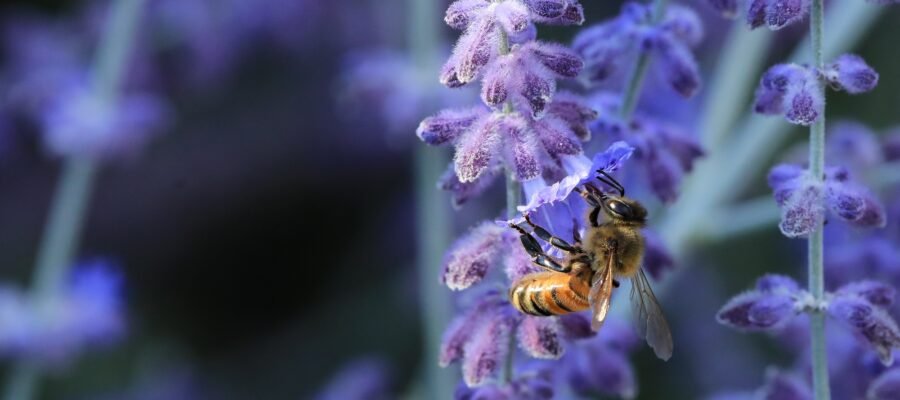
Good morning, dear #clangeorgici friends! Last week I introduced a beautiful perennial with blue flowers, and today I’d like to recommend another shrub that pairs well with it: Russian sage (Perovskia atriplicifolia), also known as Siberian sage, whose pale purple flowers add a vibrant touch to gardens and balconies from late spring to autumn. Even on sunny days in late October, it adds a splash of color to the heart of the garden, contrasting beautifully with the yellow and red leaves already preparing for autumn.
Uses of Russian Sage
- Etymology
- lassification and Distribution
- Description
- Care and Cultivation
- Minimum Planting Requirements
Planting Location
- Irrigation
- Fertilization
- Pruning
- Propagation
- Pests and Diseases
- Not suitable for pets
Uses of Russian Sage
Its scientific name is Perovskia atriplicifolia, commonly known as Siberian sage. Let’s first look at its advantages:
Russian sage is known for its beautiful blue-purple flowers, which bloom from summer into autumn (making it one of the longest-blooming plants in the garden).
Its compact form makes it ideal for planting in flower beds, vases, pots, and balconies.
It is cold-hardy and drought-tolerant. Its versatility and ease of care make it easy for even novice gardeners to manage.
Siberian sage can be planted in combination with the following plants:
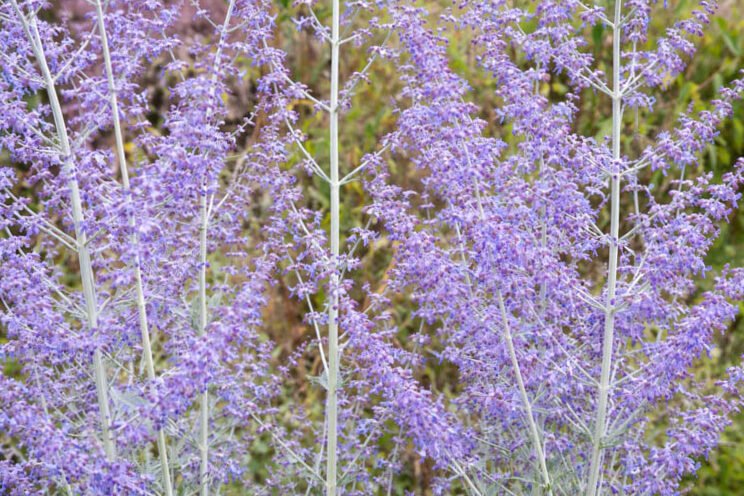
It can be planted in patches in flower beds, alone, or in combination with other plants (as mentioned above), and it can also be used in perennial mixed borders. It is also very eye-catching in outdoor pots, planting boxes, and on balconies. Siberian sage is also commonly used in prairie gardens and dryland landscapes (a gardening concept that reduces water usage by selecting drought-tolerant plants).
Etymology
First, I want to clarify that the scientific name of Siberian sage, *Perovskia atriplicifolia*, is no longer accurate: since 2017, the genus *Perovskia* has been reclassified into the subgenus *Salvia* (a very large genus that also includes common sage *Salvia aromatica*). Therefore, the scientific name of this species is now *Salvia yangii*.
Siberian sage is now commonly used in steppe gardens and dryland landscaping (a gardening concept that reduces water usage by selecting drought-tolerant plants). Its genus name, “Perovskia,” is named in honor of Vasily Alexievich Perovsky, a 19th-century Russian general and diplomat who funded the construction of the Imperial Pavlovsk Gardens in St. Petersburg.
The species name, “atriplicifolia,” refers to its leaf morphology, which is similar to that of common sage (*Salvia atriplicifolia*).
Classification and Habitat
*Perovskia* belongs to the Lamiaceae family, which also includes mint, nettle, and sedge. This genus comprises seven naturally growing deciduous subshrubs distributed in sunny, rocky regions of Central Asia, extending to the Himalayas.
Note: The genus name “Perovskia” refers to a perennial plant with a permanently woody base and herbaceous upper parts that wither during the dry season and regrow annually.
Since 2017, *Perovskia* has been a subgenus of *Perovskia* and remains classified within the Lamiaceae family.
Description
*Perovskia* plants are semi-shrubby, deciduous perennials with grayish-green leaves. They are cultivated for their ornamental terminal panicles. The individual flowers are small (7-12 mm), tubular, and bilabiate.
The pale gray inflorescence, about 30 cm long, grows at the top of the stem, accompanied by ovate, slightly serrated, and often deeply lobed gray-green leaves, about 5 cm long. Flowering lasts from late spring or early summer to late autumn.
Although all parts of the plant are fragrant, sage is not edible.
Plant size may vary slightly depending on the variety.
Care and Cultivation
Sage is easy to care for, which is undoubtedly a major advantage.
Minimum Growth Requirements
Sage, also known as Siberian sage, can tolerate temperatures from 0°C to -15°C. During dormancy, mulching helps the plant grow. Below -10°C, the herbaceous parts of the plant will dry out, requiring heavy pruning in winter.
Growing Environment
Sage prefers sunlight. Although it can tolerate partial shade, a sunny location, such as a balcony or a south-facing flower bed, is ideal.
Watering
Russian sage is not demanding in terms of watering. After planting, keep the soil slightly moist to promote root growth. Watering is recommended in spring and summer. Water when the soil is almost dry. Suspend watering during colder months. The amount of water should be adjusted according to the plant’s age: mature plants are less sensitive to water.
Fertilizing
I recommend applying slow-release fertilizer to flowering shrubs in March, June, and September. Organic fertilizer, compost, or manure can be applied in late autumn.
Pruning
Pruning should be done during the winter dormancy period, when the plant is bare. Although pruning can be done as early as November/December, I recommend retaining withered branches, as they still have some ornamental value. In late February or early March, before the growing season begins, cut all withered leaves from the woody base to the branch tip. This thorough pruning promotes flowering in year-round flowering shrubs and ensures the plant maintains a dense, uniform growth habit and continues to produce vigorous new leaves.
Propagation
Russian sage is most easily propagated by cuttings, ideally taken in late spring or early summer.
- Parasites
- No specific parasites have been identified.
- Pet-Friendly
Russian sage is non-toxic to pets such as dogs, cats, and horses.
As always, I hope this information is helpful for your landscaping. If you find anything I’ve missed, or if you have any questions, please leave a comment. If you already grow Russian sage, please share your growing experience and what methods worked for you. Looking forward to seeing you again next week! Have a wonderful day!
Ultimas Entradas Publicadas
4 reasons to adopt Philodendron brandtianum, the perfect houseplant!
Various models and big discounts in the summer sales: the deal of the day
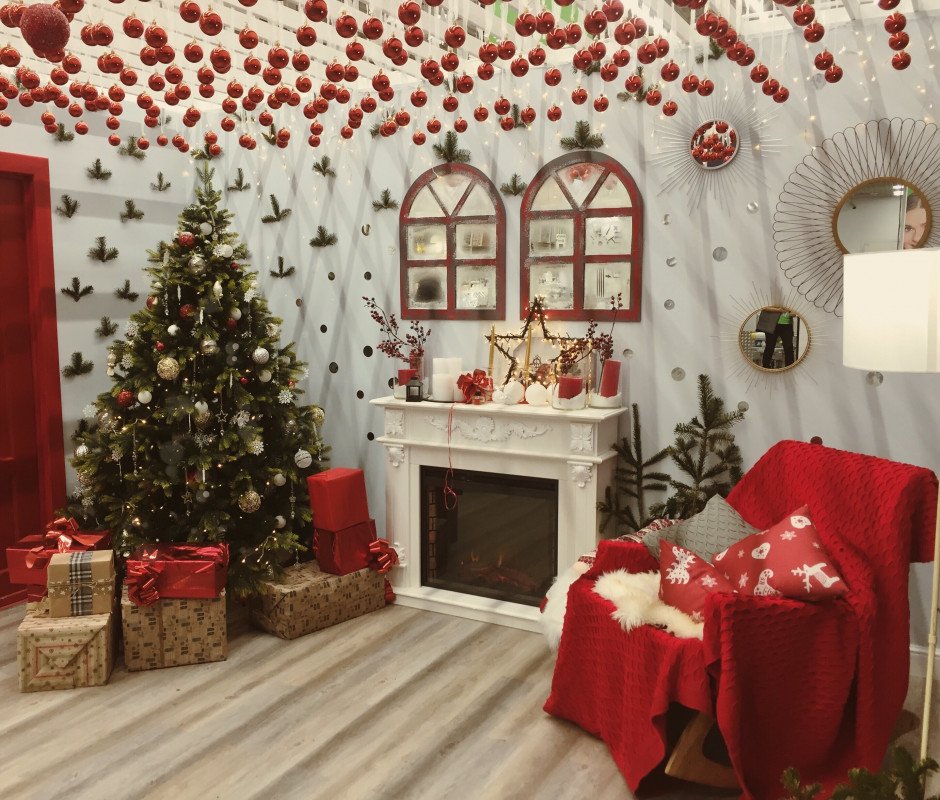
Let’s talk about Christmas decorations
– Complete calendar of holidays and events

Our favorite seasonal rugs and design tips
The most inspiring Christmas gift perfumes 2025: ideas for him and her
Camellia sasanqua, winter flower – Online Plant Sales
What is happening to our Planet?
How to build a greenhouse for succulents: practical guide