

A few days ago, I read a study on Aristolochia gigantea, particularly about the pollination process of this genus. Not everything follows the simple pattern of “bees, flowers, pollination”: the plant world is vast and we often find unusual reproductive systems, such as Aristolochia gigantea, which actually “imprisons” pollinating insects, releasing them only after they have completed pollination.
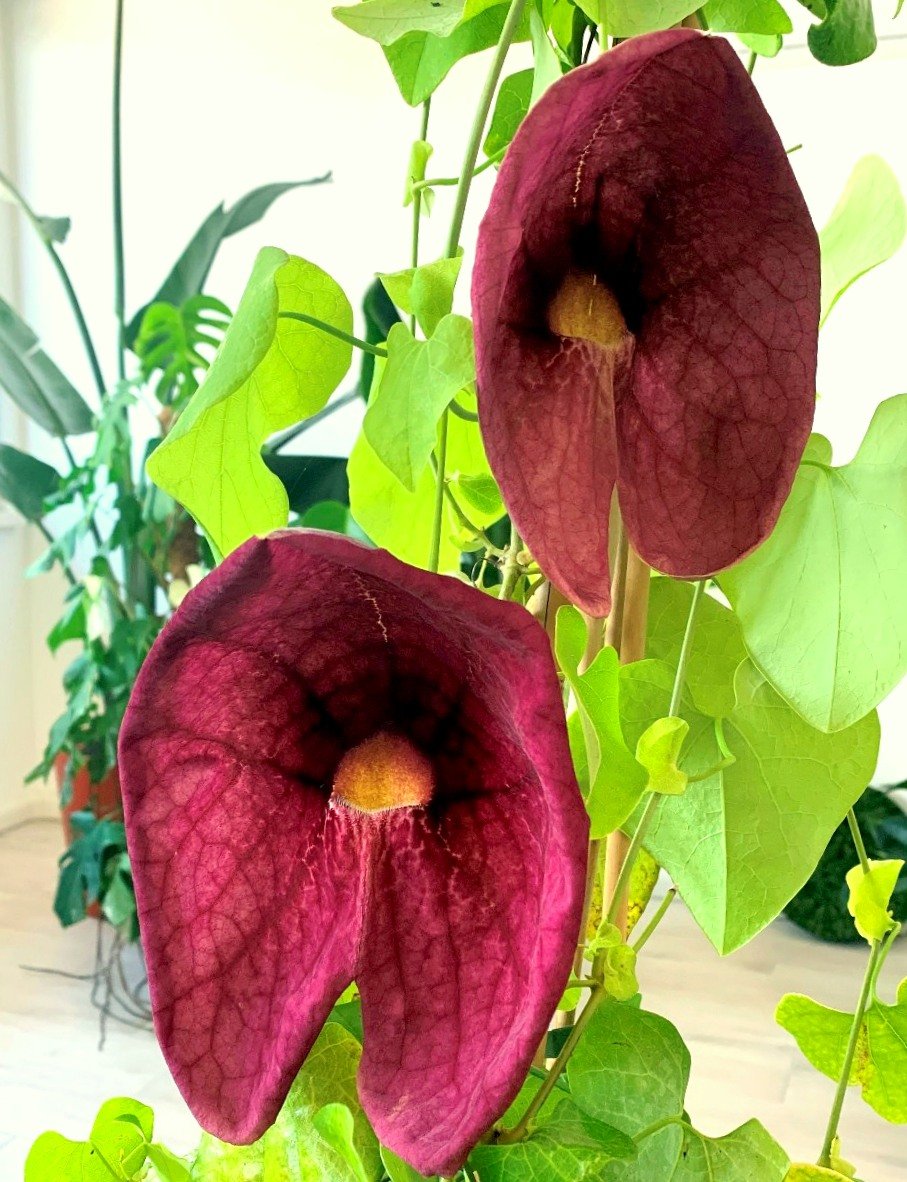
Aside from this particular process that deserves a brief explanation, Aristolochia is a climbing plant favored for its use in decorating railings, flower beds, and partition netting, and it is easy to care for once the temperature range it can tolerate is determined.
ETYMOLOGY
The genre Aristolochia It owes its name to the composition of the Greek words Aristos‘better’, and lochèia, i.e. ‘womb/birth’. The plant, widely used in ancient medicine, was considered effective for treating pain and infections related to childbirth. In the dedicated paragraph we will see how it is today considered a very toxic if not even lethal plant. According to Cicero, however, it bears the name of its discoverer (see On divination 1.10.16).
TAXONOMY
We are inside the Aristolochiaceaebotanical family including seven genera and about 400 species of plants, most of which belong to the genus Aristolochia.
DESCRIPTION
The genus Aristolochia includes both evergreen and deciduous climbing plants, many of which come from humid forests of tropical and temperate regions of both hemispheres.
They have whole or lobed leaves, often heart-shaped. The flowers, devoid of petals, have a typically S-shaped calyx (so much so that these plants deserve the common name of The Dutchman’s pipe) and the frontal lobe of the flower has veined patterns with colors ranging from purple to yellow to brown.
HABITAT
A. gigantea and originally from Panama.
CARE AND CULTIVATION
Temperature
A. gigantea can grow outdoors in climates with mild, frost-free winters. It can drop below 10°C but it defoliates; above 0°C the plant dies.
Exposure
It loves sunny positions and does not disdain a few hours of shade in the sunniest areas or in the central hours of summer days.
Watering
If grown in the garden it should be watered regularly during the summer season so that the soil does not dry out completely, taking care that it is never soaked. It doesn’t like dry soil very much and should be avoided.
Substrate
Make sure the soil is free-draining and moderately fertile. If grown in the garden it is possible to lighten any heavy soil by mixing it as required with quality substrates or coarse inert materials.
Fertilization
In the flowerbed and in pots you can use a slow release fertilizer applied in March June September, for flowering shrubs like this one.
Pruning
If necessary, intervene in late winter or early spring by pruning the shoots in order to clean the plant or manage its growth.
Propagation
By seed and by cutting.
TOXICITY’
Although widely used as a medicinal plant since ancient times, recent studies have identified aristolochic acid as a carcinogenic principle; this has limited (and in many cases banned) the use of this plant in medical preparations.
CHEMICAL MIMESIS AND TRAPS
A trait common to species of the genus Aristolochia it is the one inherent to the pollination processes, closely linked to the shape of their flower, devoid of petals but equipped with a rather unique livery and morphology. They are somewhat reminiscent of the ascidians (traps) of some carnivorous plants such as Nepenthes: the objective, however, is not to eat the insects but to sequester them and exploit them for pollination.
Chemical Mimesis: Pretending to Smell Something Else
Aristolochia plants are known for their flowers that emit a carrion-like odor, attracting flies (carrion flies) and using them for pollination. Unlike other members of the genus, *Aristolochia gigantea* emits a more pleasant lemongrass scent, surprising researchers as this scent typically repels many insects. It is speculated that this scent is intended to attract other insects, such as bees. We won’t elaborate further here, but if you’d like to delve deeper, I recommend an interesting study, linked here.
This flower lacks petals (a typical absence of a corolla). Instead, three sepals fuse within the perianth to form a sac-like structure, a downward-closing sac-like structure with its opening located in the center of the anterior lobe. These lobes are brightly colored and uniquely patterned, effectively compensating for the lack of petals. Furthermore, this flower possesses the aforementioned ability to attract pollinating insects with its fragrance.
Characteristics of the flower
The flower is zygomorphic, that is, divisible into two mirror-image halves according to a single plane of symmetry, something quite common in orchid flowers. These are hermaphroditic flowers, meaning they carry both male sexual organs (stamens) and female ones (pistils). Another peculiarity of the Aristolochia flower is that it presents these organs merged into a single structure: the androecium (set of stamens) and the gynoecium (set of pistils) are in fact united in an organ called gynostegium.
A curious case of protogyny
Here are the 4 chapters of this mini-thriller with a happy ending which has Aristolochia as its protagonist.
It may happen that, in hermaphroditic flowers, male and female organs do not mature at the same time but in a staggered manner. In the case of Aristolochia it is up to the female ones first and then it is the turn of the anthers which contain the pollen. In this case we speak of protogyny but there are species of plants that have an exactly opposite process (we therefore speak of protandry).
1. Preanthetic phase
The first phases of flower formation precede anthesis (phase in which the flower is fully functional) and are evident in the initial formation of the utricle which goes from an upright position ‘upside down’. This phase is well illustrated in this research. We technically speak of preanthetic resupination of the flower and acquisition of the curvature of the perianth. The phase ends with the completion of the flower, which has not yet ‘bloomed’ and the two frontal lobes are closed and welded together, as in the figure below.
2. Female phase
The flower opens by separating the frontal lobes. The insects, attracted by the bright colors of the sepals and the scent given off, rush towards the mouth of the canal that leads inside the utricle. The entrance is made clear by bright colours, as can be seen in the figure below.
In the first moment of the anthesis it seems that the scent is not so intense but it soon asserts itself. Inside the flower the tissues specialize to emit nectar and color themselves with very showy spots. Trichomes form in the neck of the utricle which act as guard hairs: although they allow visitors to enter and descend, they prevent them from escaping, trapping them in the utricle.
The insect (which hopefully has pollen from another flower on it Aristolochia) will remain sequestered in the flower, free to feed on the nectar produced but, more importantly, free to come into contact with the stigmas (upper parts of the pistils, on which the pollen must deposit to fertilize the ovules). The stigmas (or stigmas) in this ‘female’ phase, which lasts about a day, are open, moist, turgid and fully receptive to pollen
3. Male phase
The day after the flower opens, the female stage ends: the plant considers pollination complete. The pistil contracts and closes, while the pollen-containing stamens mature. Although the insect is still trapped, the aristolochic plant has no immediate intention of releasing it: it still has a task for it.
The stamens open, releasing pollen into the perianth segments. The pollen comes into contact with the insect, which then becomes contaminated. At this point, the male stage is also complete; what remains is to release the host plant, allowing it to carry the precious pollen to another flower in its female stage for pollination.
To release the insect, the flower degenerates its trichomes. These trichomes curl upwards and wither, allowing the host plant to crawl out through the passage it entered.
4. Senescence
Two days after the start of anthesis, the flower begins its senescence phase: the sepals begin to become flaccid until they dry out and separate from the plant; the ovary will begin to swell and the seeds will ripen following the successful pollination of the ovules.
The story ends here and I hope it was interesting to read! See you next week for a new topic, don’t forget to write to me in the comments
Ultimas Entradas Publicadas
4 reasons to adopt Philodendron brandtianum, the perfect houseplant!

Various models and big discounts in the summer sales: the deal of the day

Let’s talk about Christmas decorations

– Complete calendar of holidays and events

Our favorite seasonal rugs and design tips

The most inspiring Christmas gift perfumes 2025: ideas for him and her
Camellia sasanqua, winter flower – Online Plant Sales
What is happening to our Planet?
How to build a greenhouse for succulents: practical guide