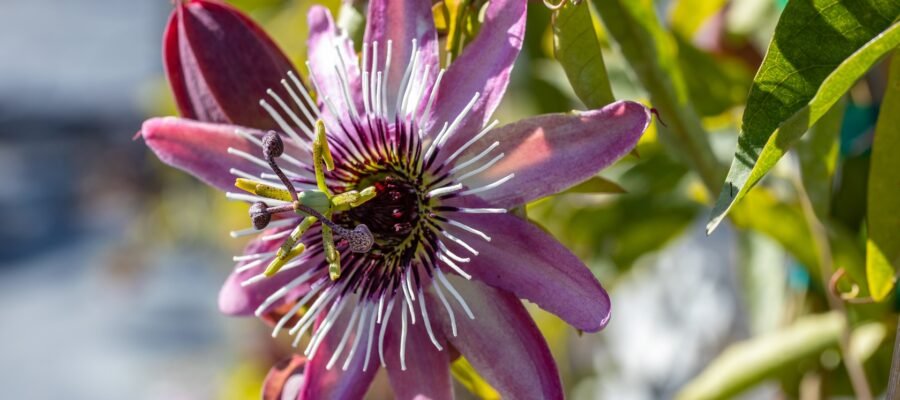
The passionflower flower is truly distinctive. Its open shape resembles a colored star. However, perhaps even more characteristic is the fruit known as “maracuja.” At first sight, it is a plant that certainly knows how to communicate a certain cheerfulness. Thanks to the colors and delicate flavor of its fruits, it is easily loved by everyone. Beneath appearances, however, it hides a profound and fascinating side—a palliative for the gaze and the mind.
For those who feel a close connection with religion, this flower is truly a soul mate. However, it certainly remains noteworthy for everyone else too. Therefore, it is worth delving deeper into the topic and exploring its knowledge!
THE PASSION FLOWER
The passion flower belongs to the Passifloraceae family, which comprises approximately 500 varieties of perennial and annual plants, shrubs, and small trees.
It originates from Central and South America, although certain species can also be found in North America, Australia, and Asia.
It is a herbaceous plant with a sarmentose habit, especially suitable for covering trellises, nets, or columns, but it can also be easily cultivated in pots, planters, or in the open ground, provided its needs are met, which we will soon learn about.
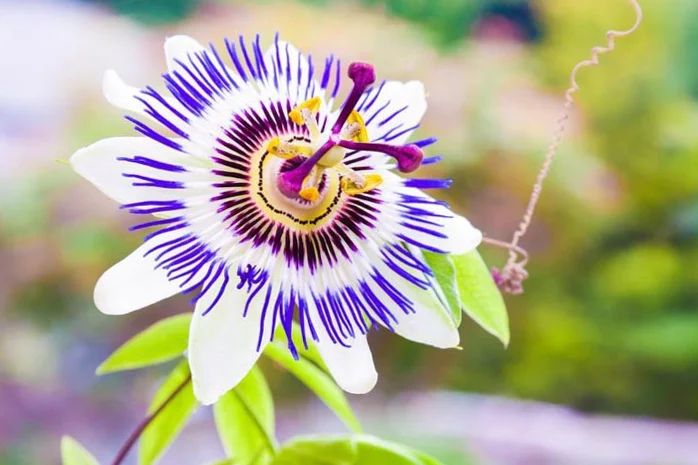
Its appearance can vary greatly depending on the variety, but it is usually notable for its shape and long petals that range from bright purple to pure white. The leaves are bright green, creating an ideal frame for the flower. The stem changes as it ages: in young plants, it is green, while in mature plants, it is covered with bark.
Flowering usually occurs from July to September.
It is very often used as an ornamental, but if left to grow in optimal conditions it can reach large dimensions which make it suitable for a pergola.
GROWING PASSION FLOWER
Despite its robust and strong appearance, passionflower requires specific precautions so that it can grow healthily. Let’s see everything in detail!
PLACING
The ideal period for planting is May. It is important, since we are talking about a climbing plant, to provide it with trellises or supports that can support it.
LAND
Its preferred soil is acidic and rich in nutrients. Furthermore, it must be well draining, so as not to create water stagnation.
EXPOSURE
This is truly a fundamental point for the good growth of our passion flower! Good lighting that guarantees a sufficiently warm temperature is very importanttherefore it is definitely better to prefer bright areas reached by the sun.
Passionflower does not like the cold, the only variety capable of surviving the low temperatures of northern Italy is the cerulean passionflowerit is therefore good to be very careful to never leave the plant exposed to the cold.
WATERING
If planted in open ground, the passion flower will be satisfied with rainwater, but be careful, it is a plant that really likes to drink. So if you see that the soil is becoming too dry it’s time to intervene.
For potted plants, however, frequent and regular watering is required.
FERTILIZATION
In Spring and Summer, add fertilizer together with the irrigation water, a couple of times a month. During other seasons, however, you can switch to fertilizing once a month.
PRUNING
It is sufficient to make a rather drastic intervention during the vegetative growth.
MULTIPLICATION
There are 2 ways to propagate passionflower:
- Seed: from October to February sow the passionflower, being careful not to expose it to excessively low temperatures;
- Cutting: the best time to take a passion flower cutting is summer, where it will be sufficient to take twigs of about 10cm to then put to rest in the ground.
ILLNESSES
Passionflower is a plant considered rustic, therefore, in principle, resistant. Of course, however, he is not immune to everything, so what should we watch out for?
- Little water. As we told you before, passionflower loves to have the soil always moist, so excessive dryness could lead to the leaves falling;
- Unfortunately it is vulnerable to attacks by some parasites, including the cochineal (manifests itself with spots on the underside of the leaf blade), the red spider (which causes yellowing and then falling of the leaves) and the aphids;
- Little light. Like water, light is essential for healthy passionflower growth. Little light could lead to yellowing of the leaves and failure to flower.
- Mosaic virus. It is a virus that could attack your plant and the only remedy is to eliminate the infected parts. It can occur in Winter and Spring and causes leaf spots and deformations.
THE PASSION FRUIT
Passionflower produces a fruit which, in most varieties, is also edible. This fruit is a berry, made up of a pulp with a gelatinous consistency and full of seeds. Depending on the variety it takes on a certain size and colour.
The fruit is known as “passion fruit” or, better, “passion fruit” as it is called in the Caribbean.
There are no inedible fruits, but some varieties manage to produce “immediately better” fruits.
In the sense that, for example, the maracuja of the cerulean passion flower has a more acidic taste and it’s not very good eaten freshly picked. It is normally consumed in the form of juice, surrounded by lots and lots of sugar. So be careful, if what you want from your plant is the delicate maracuja you tried once, don’t choose the cerulean variety!
CERULEA PASSION FLORA
Here is the outstanding protagonist among passion flowers! As previously mentioned, this plant has many varieties, but the cerulean is the most common in Italy, mainly due to its excellent adaptability to cold conditions.
It is native to Brazil and Peru, and consider this: it can bloom throughout the entire summer!
Its growth habit is usually climbing, and it yields large fruits.
Of course, the more well-known the plant is, the more hybridizers become obsessed with it, leading to the creation of many variations of Passiflora Cerulea that make it even more fascinating.
In general, if we wanted to grow passionflower in the northern part of Italy, it is best to take care to protect it from the winter cold and perhaps choose a position that is sufficiently sheltered from the wind, especially when the plant is still young. In the areas of southern Italy, the climate allows this plant to be grown easily even outside, without problems.
SO HOW CAN WE USE PASSION FLOWER?
We have already said at length that passionflower is suitable as an ornamental plant, but perhaps let’s make a summary, taking up everything we have mentioned throughout the article:
- Ornamental use: the most classic and exploited. Passionflower is a beautiful plant that lends itself to adorning homes. but also to cover walls, create fences and embellish pergolas;
- For the fruits: the fruit of the passion flower is highly appreciated and, consequently, there are those who combine business with pleasure by cultivating the passion flower to then have the fruit;
- For them medicinal properties: as we will see shortly, this plant is famous for its medicinal properties which should not be underestimated. Lovers of home remedies can’t give up having one always on hand!
THE BENEFICIAL PROPERTIES OF PASSION FLOWER
Passionflower is famous for its multiple beneficial properties.
In particular, Passiflora incarnata is rich in flavonoids and glycosides, taking on important beneficial properties, among the main ones we find:
- Calming;
- Sedative;
- Hypnotic;
- Anti-inflammatory.
THE FLOWER OF PASSION
The name passiflora comes from the Latin words “passio,” meaning “passion,” and “flos,” meaning “flower.” This name originates directly from the core of the Catholic faith. In 1610, the Jesuits invented this name because the unique passion flower combined all the symbols of Jesus’ suffering.
Even today, we can see in the tendrils the whip used to flagellate him, in the three styles the nails that pierced the flesh, in the stamens the hammer that drove deep, and in the coral rays the crown of thorns placed on his head.
Imagine that a priest was the one who brought Passiflora to Europe. In 1610, Father Emmanuel de Villegas, after visiting Mexico, couldn’t resist bringing back those flowers that Jesus’ sacrifice had bestowed upon him so much.
So, have we convinced you? We probably didn’t even need it, passionflower is a flower capable of enchanting at first glance.
Ultimas Entradas Publicadas
4 reasons to adopt Philodendron brandtianum, the perfect houseplant!
Various models and big discounts in the summer sales: the deal of the day

Let’s talk about Christmas decorations

– Complete calendar of holidays and events

Our favorite seasonal rugs and design tips

The most inspiring Christmas gift perfumes 2025: ideas for him and her
Camellia sasanqua, winter flower – Online Plant Sales
What is happening to our Planet?
How to build a greenhouse for succulents: practical guide