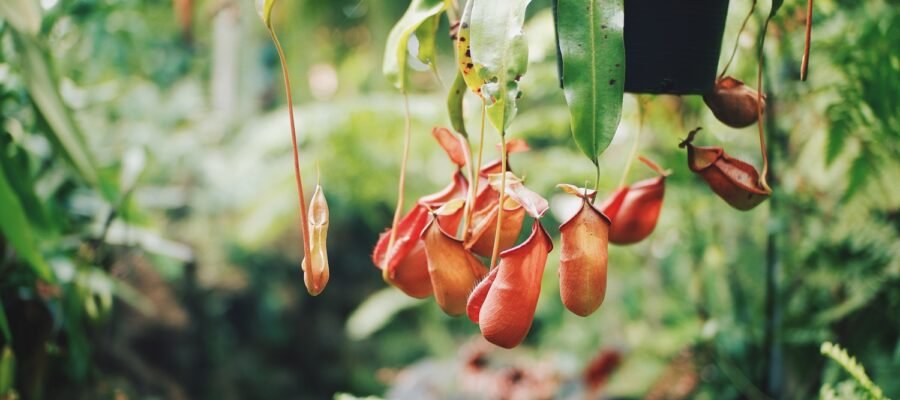
Like all carnivorous plants, it arouses great curiosity, and perhaps like the Venus flytrap, it’s considered one of the quintessential carnivorous plants. Its drooping elytra resemble wary mouths, always ready to trap unfortunate insects.
But it’s not a typical predator. As we’ll see later, it has no mechanism to force its prey into its trap. No, the pitcher plant’s trap is far more ingenious and extremely effective. You’ll never see its elytra suddenly close, yet insects always fall for it.
How is this possible? As mentioned earlier, it’s incredibly clever: it transforms into an enticing surface covered in sugar, and once an insect lures itself across the edge, it’s helpless. It’s simply a tiny black hole from which there’s no escape.
My goodness, this might sound a little scary, but that’s nature; the pitcher plant is part of an ecosystem that’s both complex and simple.
Ready? Let’s take a closer look at the pitcher plant, but don’t get too close!
THE NEPENTS
*Nepenthes* is the only genus in the family Nepenthaceae. Originating in the Indian Ocean, these plants are now found worldwide. Its name comes from Linnaeus, derived from the ancient Greek word “penthos” (pain).
This naming is significant: Linnaeus didn’t choose the name because insects unfortunately fell into pitcher plants, but because he believed that any botanist who, after a long and arduous journey through Southeast Asia, would feel immense satisfaction and joy upon finding just one pitcher plant. In short, it’s as if simply seeing a pitcher plant is enough to make all the effort worthwhile.
Another advantage is their long lifespan—so you can expect this plant to bring you joy in your home for many years to come!
*Nepenthes* typically have a climbing or creeping growth habit and are mostly epiphytes. They survive by clinging to other trees, hanging their leaves and roots to absorb moisture from the air.
THE ASCIDIANS
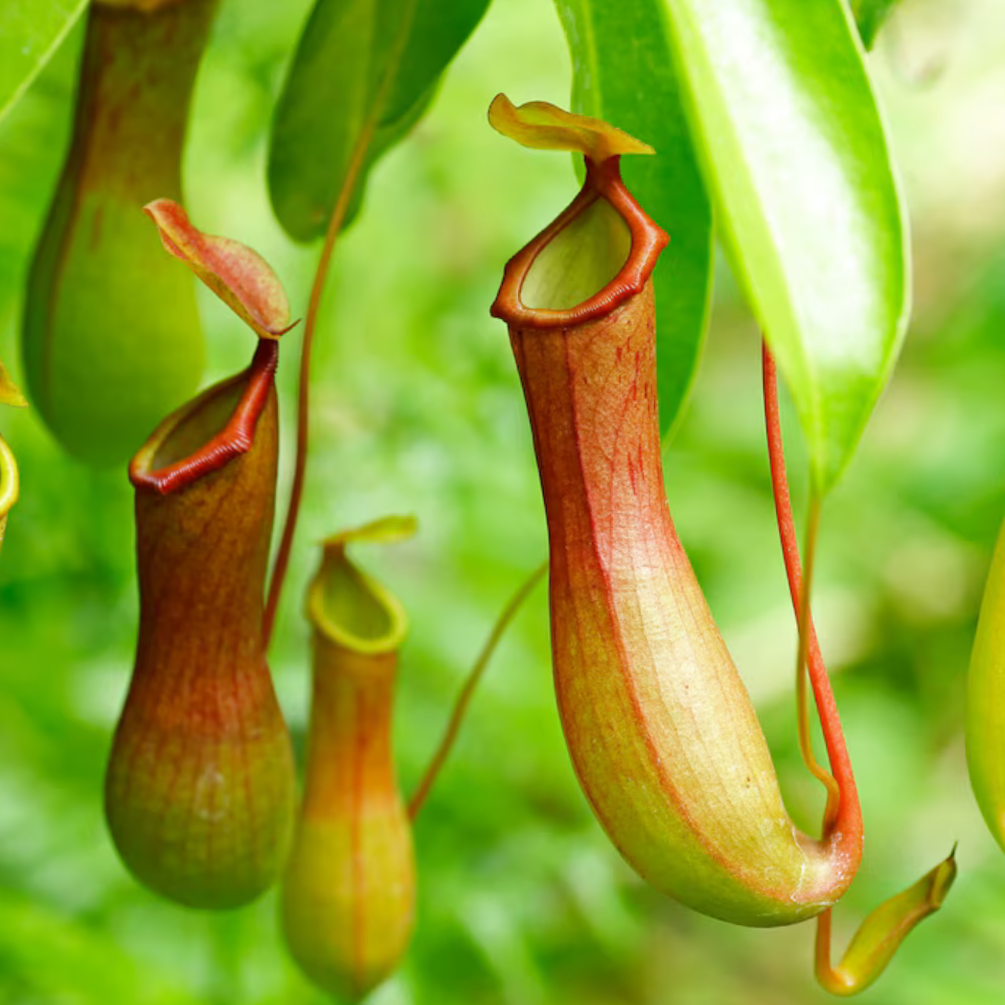
The leaves of the nepenthes have a lanceolate shape, a beautiful green and, at their apex, continue with a hook formation that ends with a sort of jug called sea squirt and that’s the real trap that the plant uses to capture insects. The trap, on its top, is surmounted by a sort of cap, which takes the name of operculumits function is not so much to close the insect inside the ascidium, but rather to regulate the quantity of rainwater that may or may not fall into the jug. This mechanism serves to prevent the gastric juices present inside the sea squirt from becoming too diluted, making the plant’s attempt to digest the prey in vain.
The great weapon of the ascidians is that they are equipped with nectar glandsespecially in the part closest to the opening. These glands have the task of secreting a sugary substance, similar to nectar, very attractive to insects which therefore arrive attracted by the bright colors and scent, and fall inside the ascidian. Inside they will then find themselves trapped in a substance comparable to our gastric juices which will consume them and allow the plant to absorb the nutrients.
They vary in size from 8-10cm, up to 30cm, we see, for example, differences in morphology between the Nepenthes alata, with more compact and smaller ascidians and the Nepenthes miranda with larger ascidians, around 20-30cm, characterized by a small crest which makes them much more particular.
Like the plant from which they originate, sea squirts are also quite long-lived, in fact they live about 6-8-10 months if always kept well hydrated.
CULTIVATION
Nepenthes is not a complex plant to keep, on the contrary, it is perfect for those who would like to begin approaching the world of carnivores. Don’t let your guard down though, she requires a bit of care too!
TEMPERATURE
Being native to a tropical area, with constant temperatures, nepenthes must be treated like real houseplants so much so that their ideal temperatures are between 20 and 25°C. We can therefore easily keep them indoors during the cold months and we are happy if we take them outside during the summer season (in rather shaded areas). We try to avoid too low temperatures which can weaken the plant making it more vulnerable to the incursion of parasites or diseases.
EXPOSURE
In terms of lighting, nepenthes require a good level of light, possibly shieldedtherefore no direct light. However, they should be placed in a bright area of the house.
WATERING
Nepenthes require a humid climate, therefore they should be bathed often, preferably showeredif you have the possibility to wet them from above with a hand shower. In this way you will be able to guarantee that there is always 2/3 inches of water in the ascidians, and in this way you will avoid them drying out. It is very useful to vaporize the leaves, keeping them healthy, still better if you use distilled water or rain water.
If you want to know, in detail, how to give water to nepenthes (and other plants), click here and read the article dedicated to watering.
FERTILIZATION
Like all insectivorous plants, nepenthes do not require particular fertilization. In reality there is a very heated debate on this topic, however we prefer not to fertilize them.
If you really want to give an extra input in terms of nutrients, in the phases of maturity of the plant and away from particular moments of stress, such as repotting, you can proceed with foliar fertilizations, with a dose of one milligram per liter, or one milliliter per liter, for example with products suitable for foliar fertilization, such as Sinergon 2000 from Cifo, or again from Cifo, Algatron, both are products that work very well for the foliar fertilizations.
SOIL AND REPOTTING
Generally, nepenthes develop in poor environments, with little land, so as far as repotting the plant is concerned, they should absolutely not be done frequently. The root system is very delicate and does not develop very much, so the plant can remain in the pot it is in for several years. If we have to repot the plant, it is best to use a sphagnum peat-based substrate, such as our universal one.
However, it is generally advisable to provide the plant with support so it can develop upwards.
ILLNESSES
Mealybugs, aphids, thrips could infect the plant, which can usually be avoided by maintaining temperatures above 20°C and avoiding wetting the leaves excessively. It is also best not to leave a saucer with water to stagnate, because this could weaken the plant and make it more sensitive to parasite attacks.
Instead, leaf spots can be a symptom of a fungal attack, so it will be necessary to resort to specific fungicidal products.
WHAT IF I DON’T CATCH ANYTHING?
This question is frequently asked, not just about pitcher plants (Nepenthes), but about all carnivorous plants.
First, it’s important to understand that it’s difficult to determine whether a pitcher plant is preying on insects. While careful care is important, unless you regularly check for each insect it has preyed on, or even witness the plant feeding, you can’t be sure if any insects are trapped in the trap. So you can rest assured in this regard.
If, for some reason, you’re convinced you can’t ensure your pitcher plant has a sufficient insect source, don’t worry!
Carnivorous plants don’t survive by preying on insects; they obtain nutrients like other plants. Insects are simply an additional food source. So don’t worry, even if your pitcher plant occasionally doesn’t find prey, it won’t be significantly affected.
LE NEPENTHES DE LE GEORGICHE
Now, ladies and gentlemen, just as the botanist at the end of his tortuous journey felt refreshed by the encounter with the nepenthes, you, at the end of this article, will meet the wonderful specimens of this plant that we host in our nursery!
Ultimas Entradas Publicadas
4 reasons to adopt Philodendron brandtianum, the perfect houseplant!
Various models and big discounts in the summer sales: the deal of the day
Let’s talk about Christmas decorations

– Complete calendar of holidays and events

Our favorite seasonal rugs and design tips
The most inspiring Christmas gift perfumes 2025: ideas for him and her
Camellia sasanqua, winter flower – Online Plant Sales
What is happening to our Planet?
How to build a greenhouse for succulents: practical guide