Does the thought of Alocasia Polly, the “Mischievous Queen,” make you feel uneasy? Does the mere mention of Black Velvet make your heart flutter? Or does the sight of Zebrina make you burst out laughing? Don’t worry, it’s perfectly normal. Like the Ficus or Peperomia we mentioned earlier, Alocasia comes in many different forms. Taking a closer look at this fascinating plant and exploring its various characteristics is definitely worthwhile!
Alocasia
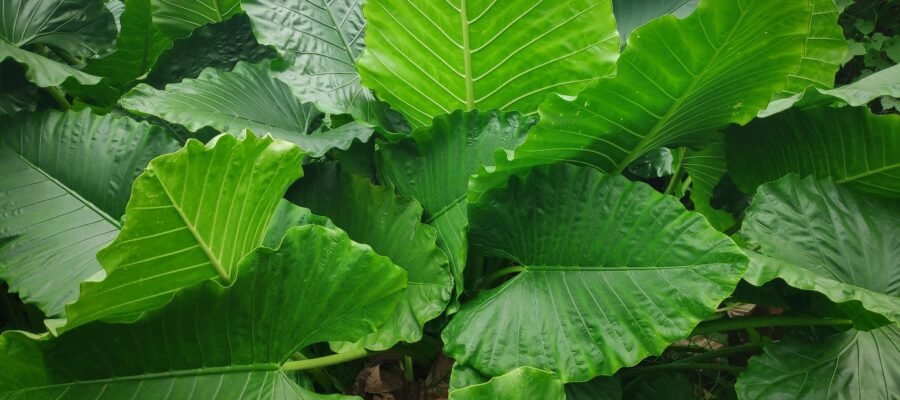
*Alocasia*, belonging to the family Araceae, comprises approximately 65 species of deciduous or evergreen plants. It is native to the sunny or shady tropical forests of Asia, Australasia, and Oceania, often nourished by streams or swamps.
Alocasia is prized for its large leaves, adorned with striking decorative veins, ranging in color from black to deep purple or bronze. Throughout the year, it produces bracts of little ornamental value, which later develop into red or orange fruits.
Even its common names highlight its uniqueness: elephant ear alocasia and African mask alocasia. Imagine the colors and patterns of an African mask—how captivating! The leaves of *Alocasia*, similar to these, are undoubtedly equally striking!
During the warmer months, Alocasia grows rapidly, sometimes producing a new leaf every week, while other leaves continue to grow vigorously. However, during dormancy, the plant almost completely freezes, remaining virtually unchanged throughout the season.
Caring for Alocasia
Alocasia is not a plant with too many demands, it adapts well to environments and can often grow quickly without too many worries.
Let’s take a closer look at it though!
Light
The ideal light is filtered light but it still requires a bright environment. Depending on the variety, you can find plants that like a few hours of direct sun, while others prefer to remain mostly in semi-shaded areas.
For those who have the possibility, it may be a good practice to take it outside during the summer months.
Waterfall
During the peak growing season (spring and summer) it is It is important to ensure a good level of humidity. Water sparingly during the winter where the Alocasia is dormant.
The soil must always be moist, but absolutely not soaked. The method of checking by inserting a finger into the soil to feel if the soil within a few centimeters is dry remains valid, in which case you can proceed with a new wetting.
Land
To ensure that Alocasia develops as best as possible, it needs loose, well-draining and rather friable soil, possibly with a pH between 5.5 and 6.5.
For those who want ready-to-use soil, we recommend Florenpot.
Temperature
It is a plant that does not like the cold, adapts well to apartment temperatures and is generally best not to drop below 15°C.
Some varieties, if left outside, die during the cold months and then recover from the rhizome with the arrival of the summer.
Fertilization
Fertilize every 2-3 weeks with liquid fertilizer during the spring and summer months, where growth is greatest. If you prefer to use granular fertilizer, fertilizations can be more spaced.
Propagation
Alocasia can be propagated by dividing the rhizomes.
I repot
it is a good practice to repot the Alocasia every year, moving it from time to time to a slightly larger pot, also taking the opportunity to renew its soil.
Furthermore, to keep the plant at a manageable size it is advisable to divide the rhizomes at each repotting.
Problems
Alocasia can be quite sensitive to some types of parasites and diseases.
Among the most common problems we find root rot and Xanthomonas (type of Proteobacteria). However, cochineal and mites can also prove to be quite insidious.
Generally, if the plant has an ongoing disease, we will be able to notice it by the presence of black or dark brown spots, with yellow edges, on the leaves.
A good way to prevent these problems is by dosing the water wellin fact, avoiding excessive irrigation, keeping the leaves dry and positioning it where there is some air circulation will make it much more difficult for it to be attacked.
Toxicity
It is strongly recommended if you have children or animals at home to keep these plants out of their reach. In fact, Alocasias are toxic, ingesting their leaves can cause swelling and irritation of the mouth and upper airways, making breathing difficult.
The Alocasia of Vivai le Georgiche
Let’s come to us now, which wonderful Alocasias find hospitality in our nurseries? We present them to you!
- Alocasia “Calidora”
Beautiful large, oval wing-shaped leaves, which if shaken by the wind resemble the ears of an elephant, with an intense green color and clearly visible veins. - Alocasia “Pink Dragon”
Beautiful large and oval wing-shaped leaves, which if shaken by the wind resemble the ears of an elephant, dark green in color, with pink stems. - Alocasia “Polly”
Beautiful large, oval wing-shaped leaves, which when shaken by the wind resemble the ears of an elephant, dark green in colour, with silvery edges and veins with metallic reflections. - Alocasia “Portodora”
Beautiful large and oval wing-shaped leaves, which if shaken by the wind resemble the ears of an elephant, dark green in color and with ruffled edges. - Alcoasia “Secret Red”
Beautiful large, oval wing-shaped leaves, which when shaken by the wind resemble the ears of an elephant, intense green and blood red in colour. - Alocasia “Reginula Black Velvet”
Beautiful large, oval wing-shaped leaves, which if shaken by the wind resemble the ears of an elephant, green-black in colour, with metallic ribs. - Alocasia “Silver Dragon”
Beautiful large, oval wing-shaped leaves, which when shaken by the wind resemble the ears of an elephant, of a veined matt silver colour. - Alocasia “Princess of Yucatan”
Beautiful large, oval wing-shaped leaves, which when shaken by the wind resemble the ears of an elephant, shiny dark green and burgundy in colour. - Alocasia “Zebrina”
Beautiful large, oval wing-shaped leaves, which when shaken by the wind resemble the ears of an elephant, dark green in color and stems elegantly streaked with yellow and black. - Alocasia cucullata
Contained growth habit and beautiful heart-shaped leaves, intense green in colour, smaller than those of other species. Also known as “Buddha’s hand”, it is placed in some regions of Thailand in front of the front door of the house, because when the wind blows, its leaves sway, almost as if Buddha’s hands were moving to greet and wish good luck. - Alocasia gageana ‘California’
Beautiful large, oval wing-shaped leaves, which when waved in the wind resemble an elephant’s ears, bright green in color and with ruffled edges. - Alocasia lauterbachiana
Beautiful wavy, spear-shaped leaves, shiny dark green above and purple-brown below, with dark stems. - Alocasia macrorrhiza “Stingray”
Beautiful large, oval wing-shaped leaves, which when shaken in the wind resemble an elephant’s ears, the margins are wavy, with a pointed and ruffled tail. The leaves are shiny green and the stems are spotted. - Alocasia macrorrhiza
Beautiful large, oval wing-shaped leaves, which when shaken in the wind resemble the ears of an elephant, shiny light green in colour, with wavy edges. - Alocasia gotii
Beautiful large, oval wing-shaped leaves, which when shaken in the wind resemble an elephant’s ears. The leaves are shiny dark green in the upper part and purple-brown in the lower part, with dark stems.
Ultimas Entradas Publicadas
4 reasons to adopt Philodendron brandtianum, the perfect houseplant!

Various models and big discounts in the summer sales: the deal of the day

Let’s talk about Christmas decorations

– Complete calendar of holidays and events

Our favorite seasonal rugs and design tips

The most inspiring Christmas gift perfumes 2025: ideas for him and her
Camellia sasanqua, winter flower – Online Plant Sales
What is happening to our Planet?
How to build a greenhouse for succulents: practical guide