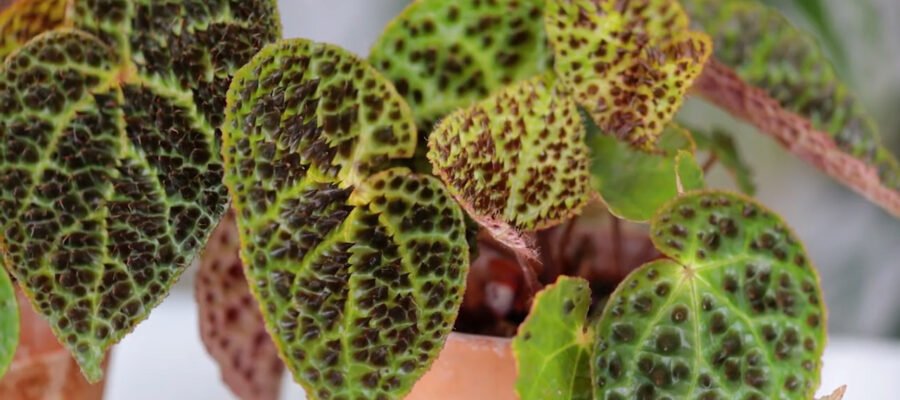
Begonia ferox is a captivating and unique plant with a wild and chic beauty. Its distinctive thorny (but not prickly) leaves set it apart from other begonias.
Besides its striking appearance, Begonia ferox also produces white or pink flowers, but these are not its primary characteristic. This plant blooms in the warmer months, and its unassuming flowers add a touch of softness to the foliage.
Its charming appearance and delicate details attract every viewer. Whether grown as an indoor potted plant or used to beautify gardens and outdoor spaces, Begonia ferox is an eye-catching plant.
In short: If you’re looking for an unusual plant to enrich your collection, Begonia ferox is undoubtedly a great choice. Learn more now!
Where should you place Begonia ferox in your home?
In summer, Begonia ferox prefers sheltered or indirect sunlight; in winter, it needs more light and therefore requires a bright or equally sheltered location.
- Where should a large-leaved begonia be placed outdoors?
- In summer, large-leaved begonias prefer bright, semi-shaded, or sheltered outdoor locations.
- In winter, due to lower temperatures, it must be brought indoors.
What temperature does a large-leaved begonia need?
Like most houseplants, it is not cold-hardy. The ideal temperature is between 18 and 25 degrees Celsius (64 to 77 degrees Fahrenheit), but it can tolerate temperatures as low as 8 degrees Celsius (46 degrees Fahrenheit).
It does not like temperature fluctuations.
How much water does a large-leaved begonia need?
In winter, the outdoor soil should always be kept fresh. However, allow the substrate to dry completely, or at least the top few centimeters (0.5 inches) to dry.
When the plant enters dormancy and loses its leaves, watering must be stopped until it resumes growth.
Large-leaved Begonia (Begonia ferox)
What substrate is suitable for large-leaved begonia (Begonia ferox)? Begonia ferox is not demanding in terms of substrate. The only important factor is good drainage and aeration. We consistently recommend our favorite substrates: One, One Plus, and One Ready!
What fertilizer does Begonia ferox need?
Fertilize regularly during spring and summer (approximately every two weeks; refer to the packaging for specific dosage instructions), adding a balanced liquid fertilizer to the watering can.
Recommended: Cifo Green Plant Fertilizer, combined with Bio-Oro Plant Growth Promoter, which promotes nutrient absorption.
- Cifo Bio-Oro Plant Growth Promoter
- During the winter dormancy period, fertilization must be significantly reduced.
- How to propagate Begonia ferox?
- This begonia is very easy to propagate through sowing, leaf cuttings, and division.
- Begonia ferox Flower Buds
- How to Prune Begonia ferox?
Pruning begonia ferox is simple: just remove dead or damaged leaves. If necessary, you can also pinch off the top of the main stem to encourage new growth.
Begonia ferox Pests and Diseases
Powdery Mildew
This plant is susceptible to aphids and thrips, and is also prone to fungal diseases such as gray mold and powdery mildew. To prevent fungal infections, ensure good ventilation around the plant and avoid waterlogging.
Emergency Treatment Mixture for Powdery Mildew (White Mold), Diluted in 1 Liter of Water:
Emergency Treatment Mixture for Powdery Mildew Prepared Using “My Organic Garden” Products
For aphids, scale insects, and thrips, we recommend using the following mixture, also diluted in 1 liter of water:
Want to learn more about these pests? You can find related articles here!
Description: Underside of a leaf of Begonia ferox
*Begonia ferox* is a rhizomatous begonia that grows in evergreen and deciduous forests and rocky areas below 130 meters in altitude.
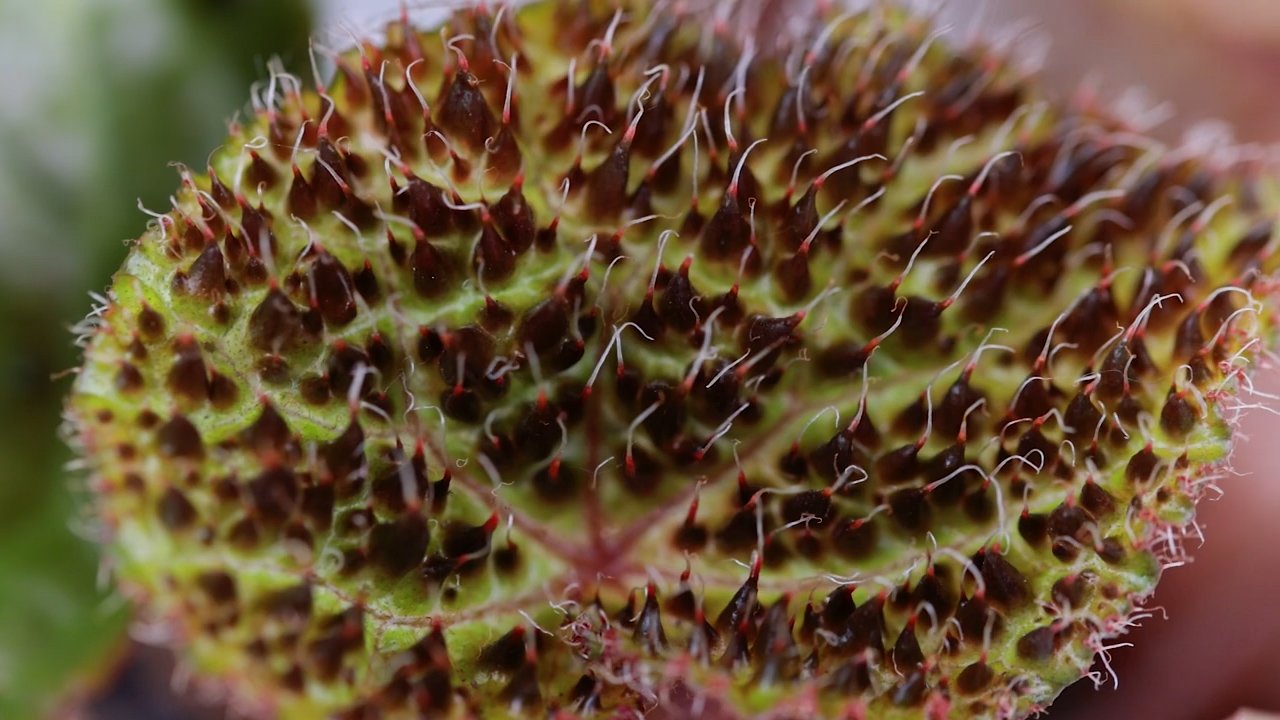
The name “ferox” comes from the “wild” appearance of its leaves. These leaves are 15 to 20 centimeters in diameter and covered with downy hairs and small, dark brown blisters (which form in mature plants). While they may not look particularly attractive, they are actually highly ornamental, making this plant unique.
Detailed image of the soft thorns of Begonia ferox
*Begonia ferox* has small, white or pink flowers clustered in inflorescences. It has both male and female flowers and produces winged fruits containing seeds.
…A little botanical knowledge
While searching for information about this particular plant, we stumbled upon an interesting paper, “Six New Species of Begonia (Begoniaceae) from the Limestone Regions of Northern Vietnam.” This article is well-written and includes a table listing six newly discovered and cataloged begonia species from the past 20 years, highlighting the differences between *Begonia ferox* and other begonia species, particularly *Begonia melanobullata*. Significant differences exist between the two species. The most important characteristics are as follows:
*Begonia melanobullata* consistently has pedicels exceeding 15 cm in length, while *Begonia ferox*’s pedicels vary in length between 5 and 15 cm.
*Begonia ferox*’s young leaves are smooth and lack a characteristic leaf tip, while *Begonia melanobullata* has a leaf tip even on its youngest leaves.
*Begonia ferox*’s young leaves have white downy hairs at the tips, emerging from a slightly reddish base. These hairs disappear on older leaves. However, the downy hairs are always present in *Begonia melanobullata*.
Young B. ferox leaves
Finally, we’d like to introduce a second study that will give you a deeper understanding of research on B. ferox and B. longgangensis conducted in Guangxi, China—you won’t be disappointed 😉
Begonia ferox is native to the tropical regions of India and Nepal. This plant adapts to cool, moist environments, such as the common mountain rainforests. Its natural habitats include hillsides, ravines, and damp areas where it can receive indirect sunlight filtered by the dense canopy of surrounding vegetation.
Ultimas Entradas Publicadas
4 reasons to adopt Philodendron brandtianum, the perfect houseplant!

Various models and big discounts in the summer sales: the deal of the day

Let’s talk about Christmas decorations

– Complete calendar of holidays and events

Our favorite seasonal rugs and design tips

The most inspiring Christmas gift perfumes 2025: ideas for him and her
Camellia sasanqua, winter flower – Online Plant Sales
What is happening to our Planet?
How to build a greenhouse for succulents: practical guide