
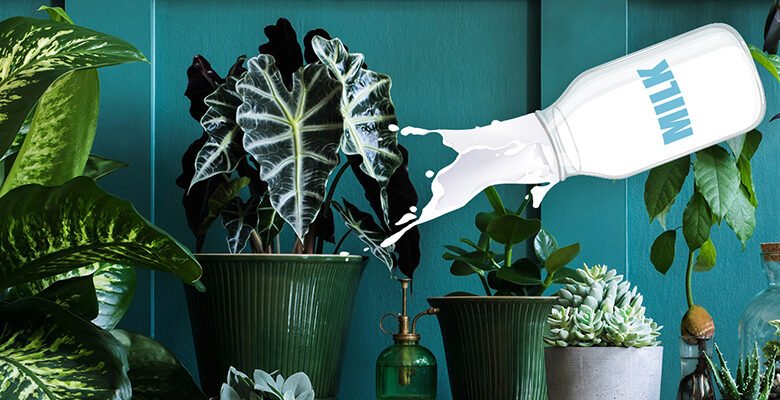
Milk is undoubtedly a favorite food for both humans and animals. This raises the question: what role does it actually play in our beloved plants?
Some believe milk can be used as a bactericide or fertilizer, while others believe it improves soil or makes leaves glossy.
So what’s the truth? Let’s find out!
The Origins of the Myth
This story alone could be made into a captivating TV series full of lies and deception. Therefore, understanding its background is crucial.
It all started around 2000 when Dave Wetzel, a former steel manager who later moved to the dairy industry, spilled excess milk on his farmland.
Soon, he and local educator Terry Gompert became convinced that this did indeed have a positive impact on the soil. According to Dave, not only did the ranch’s yield increase significantly, but soil samples also showed an increase in soil porosity.
Convinced by Weitzer’s theories, Gompert used his connections at the University of Nebraska to persuade a research team to conduct studies to verify Weitzer’s claims.
The results came in, but Weitzer’s claims differed from the actual findings.
- Statistical Data
- Dave’s boasted results included:
- Two liters of milk increased yields by 26%;
- Applying a few ounces of cod liver oil per acre increased yields by 20%;
- Applying milk and cod liver oil together increased yields by 31%;
- Soil porosity increased by 19% after milk treatment.
These figures are readily available online, but they contradict Weitzer’s claims.
Scientists at the University of Nebraska found the opposite (although the study was never formally published): “There was no statistical evidence that milk and fat affected the measured parameters. While the variety without added dairy and fat had the lowest yield (4,454 lbs/acre), the variety without added dairy, supplemented with 4 ounces of cod liver oil, had a higher yield (5,314 lbs/acre). The least significant difference (LSD) was close to one tonne (1,980 lbs/acre), indicating significant variability at this location. The coefficient of variation (CV) for dry matter was close to 25%, which is about twice the coefficient of variation we usually find in yield.”
What do these statistics mean?
In fact, not much. Or more precisely, not enough. Although the scientists measured productivity, various nutrients, and soil compaction, none of these measurements yielded significant results due to the small sample size.
Plants are living organisms; their growth times and rhythms vary. Similarly, land conditions can vary significantly across different hectares. Therefore, to obtain meaningful results, the same experiment must be repeated multiple times and compared periodically.
Therefore, the variability observed in the study was unrelated to the presence or absence of milk or cod liver oil. The tests conducted were insufficient to confirm the theory.
Wetzell spread erroneous results and disseminated this myth through journalists and writers, portraying milk as a panacea for soil.
Further Research
Dr. Sid Bosworth of the University of Vermont conducted a second study entitled “Raw Milk as a Pasture Improver” (Reference 2). This study examined the effects of raw milk on pasture yield, forage quality, and soil fertility at two farms in Vermont.
Their conclusion was: “Applying raw milk to pastures is not an economically viable method for increasing forage yield or forage and soil quality. The negligible benefits obtained are insufficient to affect milk production or constitute a reliable solution.”
Therefore, the study concluded that any benefits of milk, even if present, cannot outweigh the effort and associated costs of its distribution.
While milk is an organic product, and any organic matter added to a garden is beneficial, it must be emphasized that milk is approximately 90% water. Therefore, a liter of milk contains very little organic matter, equivalent to only a handful of compost. Milk contains amino acids, proteins, enzymes, and natural sugars, which nourish beneficial microorganisms, fungi, and bacteria, thus benefiting the soil. In short, microorganisms break down the large molecules in milk, converting them into nutrients that plants can absorb and utilize. This method can be used. However, this principle applies to all organic materials, whether vegetables, fruits, compost, sawdust, etc.
Nutritional Value of Milk
The most important nutrient in milk, especially for gardens, is nitrogen, as soil often lacks it. So, how much nitrogen does milk actually contain?
Milk contains about 3.1% protein, and protein contains about one-sixth nitrogen. Therefore, the nitrogen content of milk is about 0.5%—a negligible amount compared to commercially available fertilizers.
Another widely circulated claim is that spraying plants with milk can prevent foliar diseases. This claim stems from a 1999 Brazilian study on the control of powdery mildew in zucchini. The study also showed that milk was effective in controlling powdery mildew on other plants, including roses.
Furthermore, milk is recommended for preventing black spot disease and is hailed by rose growers as a safe and effective maintenance method.
For example, milk has been used as a binder for insecticides for decades, but with mixed results. Its most widespread application is in reducing the spread of leaf viruses, especially mosaic virus.
Advantages and Disadvantages of Milk Foliar Spraying
Potential disadvantages of using milk as a foliar spray include:
The decomposition of milk fat produces an unpleasant odor; fungi may proliferate on the leaves. Skim milk powder has been reported to cause black rot, soft rot, and Alternaria leaf spot in cruciferous plants.
Nevertheless, trying to use milk is still feasible. Some studies suggest that milk treatment can effectively protect certain crops, but there is currently no conclusive evidence that milk foliar spraying is effective against black spot disease in roses or other plants.
The advantages of milk include:
Milk sprayed on leaves can serve as a nutrient source for beneficial microorganisms, thus reducing powdery mildew growth.
Leaves treated with milk may be less susceptible to aphids, thus reducing the risk of aphid-transmitted virus infection.
Debunking Myths
“Raw milk is the best choice because heating changes its composition.”
In fact, heating promotes the breakdown of milk by microorganisms, as they break down large molecules into simpler nutrients such as nitrogen and phosphorus. Heating accelerates this process. To microorganisms, there is virtually no difference between raw milk, boiled milk, and even cheese!
“People have used milk to grow crops since ancient times.”
While there is no scientific evidence to support this claim, it is unlikely that people would discard large quantities of milk to increase yields during periods of food shortage.
“Milk has a high fertilizing effect, and even when diluted with water at a ratio of 1:5, its fertilizing effect remains unchanged.”
“We already understand the fertilizing effect of milk, but it’s important to note that any other organic matter also has a fertilizing effect.” However, even diluting the nitrogen concentration by one-fifth will not yield the same amount of nitrogen.
“Sugar is toxic to molluscs.”
This is completely wrong. While molluscs like aphids and cochineal insects cannot absorb sugar through their digestive systems, this does not mean that sugar is toxic to them. Plants contain such high levels of sugar that these insects have evolved a mechanism similar to a gastric bypass to directly excrete ingested sugar. This substance is called mucus—a very viscous substance that often serves as an early warning system during pest outbreaks.
Ultimas Entradas Publicadas
4 reasons to adopt Philodendron brandtianum, the perfect houseplant!

Various models and big discounts in the summer sales: the deal of the day

Let’s talk about Christmas decorations

– Complete calendar of holidays and events

Our favorite seasonal rugs and design tips
The most inspiring Christmas gift perfumes 2025: ideas for him and her

Camellia sasanqua, winter flower – Online Plant Sales
What is happening to our Planet?

How to build a greenhouse for succulents: practical guide